Wednesday, January 29, 2014

Packing and Resupply for the PCT

I am moving out of my current home and putting everything into storage with friends and family while I go hike the PCT .  My roommate is selling her house, so I need to pack up now and move a little over two months before I fly out to San Diego to start hiking.  I’ve been sorting resupply boxes, prepping for a couple “training” trips, doing last-minute sewing and gear projects, and organizing all my stuff.  I’ve downsized quite a bit the last few years, so it all fits into the room I rent in my roommate’s house, plus a few kitchen items and work books and papers-- but still, it has taken me a while to pack since I like to get rid of stuff every time I move.  Friends have been helping me out which has made this whole process easier.
Still Waters helps me sort and label my spare gear so I can keep track of it.
Labels on my spare hiking clothes. Can you tell I'm undecided about clothing?
Labels on my spare gearSome of it I don't use anymore, but I hold onto it "just in case"-- sigh...

Putting stuff into storage
I am going to distribute my stuff (both my gear and my non-hiking-related possessions) between my parents and four of my friends here in Georgia.  My folks offered to keep all my stuff at the house in Wisconsin (which is where they retired to), but since I doubt I'd want to live there, I am just giving them my "valuables” to store- photo albums, rugs, and a few pictures.  I don’t know where I’ll end up after hiking the PCT, but keeping my other stuff (i.e. my clothes, sewing supplies, books, and kitchen supplies) mostly in Georgia with my friends just feels right.
Things my parents will store for me: portrait of Darwin, and prints drawn by my grandma of Mt. Hood and the Oregon coast.
Resupply boxes
Because I am moving soon, and will be living out of my suitcase and backpack after that, I’ve gotten most of my resupply boxes together already.  There are various ways to get food along the PCT, and I am choosing a mix of strategies.  I cooked and dehydrated my favorite, homemade no-cook meals for about 7 resupply boxes, most of which I'll supplement with snacks I will buy in towns.  Still Waters has generously offered to send 5 resupply boxes to me at various points in So. Cal and the Sierra.  Then, in larger towns I’ll buy all my food for my resupply.  I will also box up and ship food to myself to places that don’t have good selections- like some places in Oregon and Washington. 
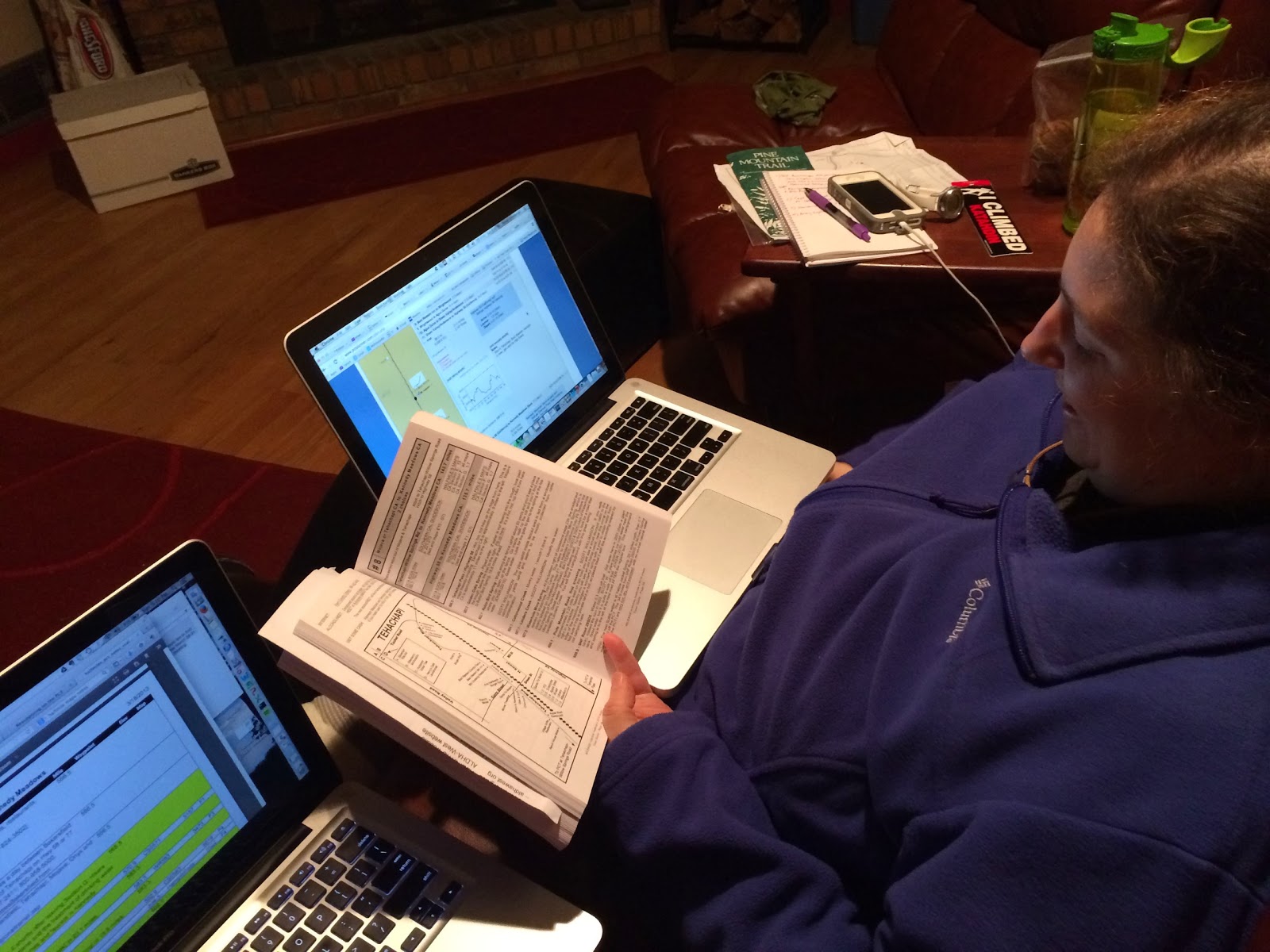
Renee and I used Craig's PCT planner, Yogi's guides, and Halfmile's notes to get rough estimates of our resupply stops and how much food to send or buy.
Sorting my homemade, just add cold water meals into resupply boxes.
My parents- meeting me on the trail
My parents are also going to be visiting me a few times while I'm on the PCT.  They love to hike and travel, and I think my dad especially would join me on the trail if he could.  But meeting me at trailheads and in towns will be a wonderful way for them to share the adventure.  They plan to meet me in So. Cal. before I head into the Sierra, then again in Nor. Cal, and then Oregon.  They will travel and sight see on their own and then meet me, helping us resupply, then taking us back to the trail. (Note: if anyone has suggestions for places for them to stay near the trail that are scenic and uncrowded especially in Nor. Cal., please let me know!)
  
They are driving down to Georgia this weekend to pick up “spare gear” and 2 resupply boxes (mostly dinners I dehydrated).  I am giving them my warmer clothes for the Sierra, rain gear and passport for Washington (the Canada entry permit is being mailed to them so they can get that to me as well), a couple plant identification guidebooks (yay!), and extra stuff for gear repairs and replacements.  I have no idea if I'll need any of this spare gear, or how easy it would be to otherwise pick this stuff up along the way, but since I already have it, I figure I might as well give it to them.

My parents have been doing some preparations of their own, looking over maps, and they both finished reading "Wild."  We've had some wonderful trips in the past so I know that having them out there will be really fun.
Dad suggests foraging for edible plants to supplement my diet on my thru hike. <haha!>
Mom says to find good, strong trees like this one for hanging my hammock.
Final thoughts...
It has been an interesting process to try to figure out how to share my journey, to plan for how I will get support.  Often, I find it difficult to ask for help (finding it much easier to help others, much harder to receive help).  In the past I was drawn to the self-sufficiency of backpacking, to the concept of carrying everything needed and nothing more.  One of the things that's becoming more clear to me is how wonderful and important my connections are- people care about me, and they also believe in and are supportive of 'living the dream.'  I am learning that when people help me, they become part of a shared experience that enriches all our lives.  I expect I will continue to learn more about this part of long-distance hiking.

Thursday, January 23, 2014

Bushwhacking to hidden waterfalls

I'd had been intrigued for several months about this one particular trail along the Blue Ridge Escarpment in South Carolina that I could not find out much about. There are typically two reasons for a lack of information in guidebooks and online reports about a placel- either it is (1) not noteworthy enough to warrant space, or (2) a well-kept secret.  I made some inquiries, and learned this area had a "treasure trove of waterfalls"  that weren't marked or on the main trail.  There were also some warnings-- "some seriously steep terrain”….. "evaluate risk/safety issues”  ….  “full-contact bushwhacking”….  Oooo!  FULL-CONTACT-BUSHWHACKING!  My kind of place!

Off-trail travel
I set out on a solo backpacking overnight.  When I headed off-trail in the direction of the waterfalls, I had to negotiate my way over blowdowns, briars, and icy patches.  I was glad I'd kept my pack relatively light (in contrast to the last few months as I've been trying to carry more weight to prepare for the PCT).  I really appreciate the high level of engagement required for off-trail travel-- getting to read the landscape to find your own path.  There are still false starts and backtracking, so the going can be slow, but this trip wasn't about covering miles or winning any speed records.  
How will I get down there?!?!
Oh my, how will I get down there?!?!
I knew I was close when the terrain got steep and I could hear the deep roar of the falls echoing across the valley.  That's also where I found what distinguishes "full-contact bushwhacking" from regular bushwhacking--  fingers grasping at the dirt and mud, skooching on your belly down the cliff, reaching for footholds, awareness of the pull of gravity.  Feeling small and insignificant, and yet, interconnected and part of nature.  In essence, totally alive.
What a gorgeous waterfall!
Another hidden falls!
The valley of hidden waterfalls was incredible beyond description.  There were few signs that anyone had ever been there- and no signs anyone had been there recently- no trash, no footprints, no cleared or broken branches.  My photos just don’t capture it, but maybe you can tell from my expressions just how awesome and wild it was.  Finding them felt like an exhilarating discovery.  Or maybe it was just the endorphins.
Yet another!
The value of wild places
If I saw a falls like this from an established trail, it wouldn’t spark such enthusiasm. 
Sure we need accessible trails, but we also need trail-less areas and places that aren’t on the maps.  The idea of building a trail or boardwalk to these falls makes me cringe.  Their beauty was exceptional precisely because of they were difficult to access.

Places like this that are mostly untouched capture the imagination.  For daydreaming when I'm stuck in a city.  For keeping me excited about new places.  For keeping my eyes and ears peeled for hints of what lays beyond the edge of view.  When I'm heading down an established trail and hop across a little babbling stream, I can imagine that a few hundred feet down, joining other streams, there are falls tumbling into a waterfall valley of wonder.

As I crawled my way back up the cliffs, I did my best to try to not leave even footprints (easier in theory than in practice!)I didn't want to rob the next person of the feeling of going out into uncharted territory (also this article on LNT and bushwhacking).

So... you may have figured already that I am not going to tell you where this exact place is.  The important thing is knowing that it's OUT THERE.  If you need to go somewhere like this, I am certain you can find it, or something like it.
Saved the biggest falls for the next morning.
It really did get cold overnight- forecast said 15-degrees.  Look at the ice!
Notes and resources:
Here is where I normally tell you the maps and guidebooks that provide info on the route.  Instead, check out these inspiring books:

Desert Solitaire by Edward Abbey
          -My all-time favorite book.  Inspiring and irreverent.  About many things including our relationship with nature.  Will make you want to visit Utah and the southwest.

Backwood Ethics by Laura and Guy Waterman 
         -Includes chapters are on fires, thru hiking, bushwhacking and the history of Leave-No-Trace (LNT) ethics.  This book explains the variability in why people get out and the benefits of different approaches- especially helpful when trying to figure how we can all get along in the backcountry. 

Listening for Coyote: A Walk Across Oregon's Wilderness by William Sullivan     
         -Sullivan made his own path across Oregon and writes about his journey and the interesting people he meets, and mixes in views on wilderness and land use.  Inspiring!

Monday, January 13, 2014

Winter Backpacking Food Favorites

I’ve mentioned before that my backpacking menu changes with the seasons (my summer favorites here).  In winter, flavorful and hearty meals taste good in the cold.  I like to adapt dishes that I normally eat at home for the trail.  This works for me because I cook (most of) my meals from scratch using seasonal veggies when possible.  When I cook my dinners for the week, I often make a double batch so I can put half on the dehydrator.  Stews and curries are especially satisfying and dehydrate well.
Rehydrated by adding cold water.  Doesn't look like much but it was delicious!
Here are a few dishes, with links to the original recipes, that I’ve cooked and then dehydrated this winter (details and photos below):
     Curried red lentil stew  -hearty and satisfying.  I doubled the spices.
     Roasted vegetable soup  -roasting the veggies enhances the flavor.  I omitted the white beans, and sometimes substitute sweet potatoes instead of squash.  One of my favorites!
     Moosewood mushroom curry -a tad sweet and tangy. I doubled the spices here too.  I also dehydrated jasmine rice to go with it, and topped it with unsweetened shredded coconut.  When I make it for home, I like adding tofu, but tofu takes longer to rehydrate so will omit it next time.

At home
I cooked these recipes using less water and half the oil which helps for dehydrating.  Be sure to cut everything up into small chunks.  The recipes are very forgiving so feel free to make substitutions.  The important thing is the rich flavor, and adding plenty of spice.   Spread them thin on the dehydrator trays to dry overnight.  Then once they were totally crispy, I repacked them into ziplock freezer bags and added some freeze-dried chicken.  
Roasting the veggies for soup
Cookin'
Red lentil curry is done when it is brittle and crispy.
On the trail
I still go stoveless (yes, even in winter!) and these meals rehydrated in less than 4 hours with cold water.  I just  eyeball how much water to add to reconstitute my meals, but it’s a good idea to check to make sure you added enough water about an hour before you want to eat, just in case it was an underestimate.  Stews are forgiving because if you add to much water, its just more soupy.

I keep the rehydrating meals in the "warming" pouch of my hoodie (i.e. the front pocket) when it is below freezing to help them rehydrate and to prevent them from freezing in my pack (or thaw them if they already froze in my pack cause I didn't realize how cold it was out!).  I made sure to double bag them or put them into an opsack to prevent them from spilling all over my clothes.  Sure glad I didn't meet anyone out on the trail because this is what carrying dinner (plus my water) in the pouch of the hoodie looked like...
Rainpants complete the look.
Of course you could just take a stove, and then just do the freezer-bag cooking method of just adding boiling water and allowing it to rehydrate in your pot cozy for a short while.

Protein
I’ve also been experimenting with various protein sources, and I found that adding freeze dried chicken to all of these dishes was easier than cooking them with added chicken, and then dehydrating that all together (I tried it both ways).  The freeze dried chicken soaked up the flavor quite nicely and reconstituted well in cold water.  But if you can't find the freeze dried stuff on sale, either way works fine.  

I also add freeze dried cheese to various dishes like chili, and it also fully hydrates in cold water.  Of course there is also no reason not to carry fresh cheese when the weather is so cold.
Freeze dried cheese added to a dinner, then vacuum sealed (for longer storage).
And for afters...
Having extra calories right before bed helps me stay warm over the course of the long dark nights of winter.  Look for higher fat instant pudding like this “Greek yogurt” style and mix it with some Nido milk powder.  Then in camp, just add cold water (don’t add too much- add it little by little!), stir or squeeze the bag vigorously, and it will set quickly (especially in the cold).
High calorie dessert to stay warm
I also make my own version of pumpkin pie pudding by making pumpkin “bark” (see recipe from Backpacking Chef).  I run the bark through the food processor to turn it into a powder because that allows it to rehydrate faster.  A scoop of protein powder, some dried coconut, and almonds also increase the fat and protein content for longer-burning fuel, which really help me stay warm at night.  Great excuse for desert!
Making the pumpkin pie pudding

Friday, January 10, 2014

Shakedown #2: Bear Canisters & Gear Minutiae

Renee (Pathfinder) came down to Georgia over the holidays for another shakedown trip for our Pacific Crest Trail thru hike (our previous shakedown trip here).  Neither of us had previously carried our bear canisters packed with 6-7 days of food, but we wanted practice for when we get into the Sierra.  We were joined by Susan who is hiking the PCT as well (YAY!).  Susan was the trip leader on my first backpacking trip with Sierra Club, is a fellow naturalist/ salamander hunter/ wildflower enthusiast, and is all-around AWESOME.  I’m so thrilled the three of us will be starting our PCT adventures together in only 3 months!
Susan, me, and Renee/Pathfinder.
Our route
This "practice” trip for the PCT, ironically enough, took us to the terminus of the Appalachian Trail (AT) in Georgia, starting at Amicalola Falls State Park up to Springer Mountain (with a visit with Hammock Forum friends- nice to see you guys!), and then north to Woody Gap.  Due to winter weather, we then headed to lower elevations on the Chattooga River Trail near the South Carolina/Georgia border to continue our trip (out and back between SC 28 and Sandy Ford Rd).  (Thanks again Kellye for the weather advisory and ride!!!!)
Susan and I on Springer Mountain on New Year's Eve.
The Chattooga River near Dicks Creek Falls was plenty cold- it still got into the low 20's.
Bear-can-love
One of our goals for this trip was to practice carrying bear canisters.  I recently bought a bear canister (BV500) for my PCT trip, and though I’ve been shlepping the bear canister around (here and here), this was the first time I’d tried packing it with six days of food plus the first day’s food outside the canister.  While bear canisters are required on certain parts of the PCT, using them in Georgia is quite uncommon, and they are only recently required here (i.e. on the AT near Blood Mountain during thru hiker season).
Trying to get all the food into the canister.
Adjusting to carrying the bear canister involved several steps- figuring out how to repackage and organize food in the can, and select more calorie-dense food, rearranging all my other gear in my backpack with the canister (the bear can is bulky!), getting used to how the backpack feels on my back with the canister (it’s very heavy!), and learning how to open the canister when it is cold (use this card opener method).  Learning these skills BEFORE I am out on the PCT will hopefully allow me to better enjoy being out there in the gorgeous scenery rather than fiddling (as much) with gear.
Reflective tape for finding the cans in the dark.
I’m a total convert to the bear canister!  It saves time not having to hang the food.  With the short winter days, I don't have the frustration of throwing the bear line in the dark.  While I’ve gotten much faster at hanging my food and never had critter problems, my food hangs have been less than textbook a few times-  due to things like branches falling down, camping in pine forests with no reachable horizontal limbs, getting line stuck in the tree, or in dark/ rain/ dense fog.  A bear can eliminates the time spent on bear-bagging misadventures.  And most importantly, the bears (in the Sierra) won’t eat our food and then become problem bears- or dead bears.
Huddled under my tarp on the AT.  Probably the only bear canisters and umbrellas around for miles.
From gear angst to gear minutiae
You might recall that our first shakedown trip two months ago involved high levels of gear angst.  We were worrying about changing our gear for the different conditions we anticipate on the PCT.  We were struggling with the awkwardness of new gear (i.e. our packs, lighter shoes, electronics) and trying to be open-minded about change. 
Playing around with our water systems.
Two months later, we finally made it to the point where we decided to keep the gear we've loved on the AT (making some adjustments of course), and we have largely transitioned to a new stage which we jokingly call "gear minutiae."  Little trivial changes.  We have most of our gear to start the PCT, and yet, we can't help but try to improve, streamline, and optimize.  Cut an ounce here and there.  Platypus big zip vs. hoser?   In-line sawyer vs. sawyer squeeze?  Icebreaker 200 vs. 260 weight long johns?  Do I gotta get a new buff because my old AT buff would be totally dorky on the PCT?  ... seriously... none of this minutiae will make or break our PCT experience.  But it gives us somewhere to channel our ridiculously bubbling-over, out-of-control excitement.

Is it time to start hiking the PCT yet? 
We're feeling (almost) ready.

Obligatory photo of lovely, glimmering, tree foam!  Woo hoo!

Monday, December 30, 2013

Hammock on the PCT?

Many people have ask me if I'm planning to take my hammock next year on the Pacific Crest Trail (PCT).  The answer is YES!
My hammock and tarp.
When I decided I would hike the PCT next year, I had a ton of questions about hammock use on the PCT I wanted to bring my hammock (it's my most beloved piece of gear), but I was worried it would be too difficult for me to hang in Southern California.  Then, I found a
post on Hammock Forums (HF) asking if anyone was planning a thru hike on the PCT in 2014 in a hammock.  Ah ha, yes!  It turns out that hanging on the PCT has been done before by several hammock hangers (see "resources" below), and they offer some good advice.  Three other hammock hangers are planning to go in 2014!  Woohoo! (I take this as evidence it's not too crazy!I've learned much, especially from Jim (PITA) who started that post on HF and who has been patiently answering my questions, follow up questions, and requests for further clarification (THANK YOU, JIM (PITA)!).  

Here, I thought I'd fill you all in on what I learned so far, describe why I think hanging is a good choice for me, tell you about the shelter and sleep system I plan to take on the PCT, and list hammocking resources in case this will be helpful for others.  I also want this to serve as a record so I can see how my ideas about hammocks on the PCT change during my hike. 

Questions and answers about hammock use on the PCT  

What about the “desert” section in Southern California?  Are there hang sites (anchor points) for a hammock?
Southern California is not a vast treeless expanse- there are forests at higher elevations and trees in valleys especially around natural water sources- it is quite a diverse area.  You can see this by looking at photos of tent sites and water sources in Guthook’s Guides, eTrails, and various trail journals.  In the absence of trees, it is possible to hang from small bushes with deep roots across ravines.  It also may be necessary to "get creative" to find anchor points (ohh I love a challenge!). 

What about the Sierra?  What about above treeline?
It is possible to camp in the valleys between passes that are below treeline, and in fact this is what people with tents do as well.  Above treeline, I can choose either to hike further, or set up on the ground.  Tenters have to deal with similar issues in finding flat spots.

What about burn areas?
I can always go to ground.  Though it may be possible that some trees in burn areas survived when they are in protected areas in valleys.  It may be possible to hang from dead/burnt trees (this will be dirty and highly risky), and if I go this route, I certainly know to do a “shake test” of the tree first (don’t worry, Kellye, I will never forget THAT lesson when you showed me that tree that fell down!).

Aren’t hammocks heavy?
My sleep system and shelter are 4.3 lbs (see my PCT hammock gear below).  "Heavy" is a relative term and it's not obvious to me what to compare this to.  From what I can infer, this is on the heavy side compared to a tarp w/bivy or bugnet, but not too far outside the normal range for a tent setup (What's normal anyway?  That's not usually my department, so I could be totally off about this...).  

The biggest weight penalty seems to be the bottom insulation.  If I could be comfortable on the ground with a closed foam pad instead of my underquilt and torso/foot pad (which together are 17 oz), sure that would be lighter.  However, compared to a full sized inflatable pad + a pillow + closed foam sit pad for my pack, the weight is comparable.  Regardless, I am OK with 4.3 lbs for my sleep system and shelter and would rather reduce my pack weight in other areas than be cranky from not getting enough sleep on the ground.  
Happy in my hammock.
Why I think a hammock is a good choice for me 
I don't want to imply that hammock hanging on the PCT is for everyone.  It's not.  But these are the reasons I believe it is suits me. 

Quality of Sleep
The main reason I am taking my hammock is because I sleep much better in a hammock than I ever did on the ground.  Getting good quality sleep and having less sore muscles are priorities.

Go-to-ground-option 
I already have everything I need to setup on the ground using my torso pad and groundcloth.  Even though I call it a "hammock" setup, I actually have a separate tarp and hammock, making it a versatile system that allow a variety of configurations given the conditions and weather.  The tarp sets up on the ground with hiking poles.   Rain is not common especially before Washington, but still, I will be prepared.  I could also "cowboy camp" which is sleep out under the stars- this seems to be very common and many PCT hikers report only setting up shelters a handful of times during their entire hike.  If there are bugs, I have a headnet if I don't want to set up the hammock on the ground to risk abrasion (which I don't).  Though I think it less likely that I will be in a spot where there are mosquitoes and no trees, since mosquitoes, water and trees tend to co-occur.

I'm not carrying much extra to go to ground- the torso pad serves multiple functions- it fits in the sleeve of my backpack as a “frame”, I can sit on it during rest breaks, and then in the hammock it acts as the insulation under my legs (my short under quilt only covers my torso).  I usually carry a smaller sit pad but have gone with a longer one for the PCT.  The groundsheet is useful under my hammock for keeping my gear cleaner and for standing on when I get into and out of my hammock.  I sometimes bring one anyway, but this is a larger size.

It's what I know
I’ve been hanging since 2010, so it’s where my skills are most developed and what I am comfortable with.  I have a search image so I “see” hang sites with suitably spaced anchor points-- if you are a hammock hanger you’ll know what I mean.  Also, I already have hammock gear that I have used in a variety of weather conditions and know how to troubleshoot problems.

I'm OK not being able to camp in open areas
Other people like camping in open spaces with views or sunsets, but that’s not previously been my style.  Hiking is my priority, not spending time in camp.  I typically walk until dark and then go directly to bed, so I don’t value scenery much at night.  I want somewhere warm, sheltered, and where I will sleep well.  As a “morning person” I love packing up early and watching the sunrise while I am hiking, and I enjoy seeing views during the day when I am awake.  If it turns out I change my mind and find I want to camp out in the open for some reason, I can, as I've said before, go to ground.

Tree-hugger at heart  
My friends and family joke that I am a tree-hugger and it's true- I am a plant geek.  Since I started hanging, I have learned the forest types most likely to have suitable hang sites, and I anticipate and predict these from topo mapsObviously there will be a learning curve since I'm most experienced here in the southeast.  But I really enjoy trying to understand plant distributions so I think I will learn quickly.  Plus I don't really think it's going to be rocket science or anything- in So. Cal trees are going to be near natural water sources, and those are on maps and databooks and I'll be walking to them anyway for water.
Being a tree-hugger is a bit more challenging in some places.  But I still manage. (Note: I know this is not actually a tree.)
My PCT Hammock Gear (Shelter and Sleep System ~4.3 lbs) 
This gear can get me down to the 20's (and is great for the 30's) here in the southeast where it is more humid than it will be out on the PCT- so I should be OK.  At night, I wear down booties, long underwear bottoms, fleece hoodie, and my down jacket zipped around my head and neck.  Obviously this gear will be subject to change in the next 3 months and also when I get on the trail. 
Tarp-  Hammock Gear Standard Cuben Fiber with Doors (11') in Real Tree Camo, with guy lines and ridge line, 9.2 oz.

Tarp skins- DIY, made with .7 oz/sqyd ultralight insect netting, 0.8 oz.

Stakes- 4 titanium shephard hooks, 2 MSR groundhogs, 2 MSR easton aluminum 6” stakes in bag, 2.2 oz.  


Hammock w/ integrated bugnet-  Dream Hammock Darien UL (10’), 10 oz.

Hammock suspension- 10 ft tree straps, 8 ft whoopie slings w/ whoopee hooks (note: edited), 6.0 oz.

Groundcloth- Tyvek 36” x 80” (will cut this smaller when I test it), 4.5 oz.

DIY top quilt- Karo baffle-style, 3-4 inches loft, DWR Argon fabric w/ DWR 850 fp down, 19 oz.
     
Underquilt- 3-season (20-degree) Warbonnet Yeti, 11 oz.

Torso pad/ leg insulation/ backpack frameZlite sol, 6 sections (20x30), 6 oz.

Resources for hammock use on the PCT
There are a few trail journals by hammock hangers on the PCT-- all very positive about hanging on the PCT, and mention how they were able to sleep very well.  Three hammock hangers have completed the PCT in hammocks (Roni, Luke Sierrawalker, and Stryder).   Two thru hikers (Chop, guySmiley) hung partway but say “next time” they’d hang the whole way.  Other hammock hangers have hiked parts of the PCT with a hammock (the Ewoks, ClayJar).  There may be others, but these are the ones that kept trail journals that I know about.  Below are links to their trail journals, but the most helpful information are provided in the forum links or summary posts listed below each name.

Hammock hangers on the PCT- click on trail names to link to their trail journals

1. Roni (from Israel) nobo 2003.
      3/2004 PCT-L post.
     4/2007 post with summary of his experience with hammocks on the PCT. 

2. Ender (one of the "Ewoks") 2003.
     -switched to a hammock at mile 344, and made it to Donner Pass.
      2/2012 White Blaze- "Hammock use on the PCT".

3. Swope (AKA guySmiley on Hammock Forums) nobo 2010.
     -switched to a hammock in WA (but said would take it whole way).
     5/25/2009  Hammock Forum- "Hanging on the PCT"  

4. Luke Sierrawalker, sobo 2012.
     11/2012 excellent review of hammocking on the PCT and a list of hang sites in So. Cal.

5. Stryder, nobo 2012.

6. Beardoh! (AKA Chop on Hammock Forums), nobo 2012 - started on the ground, but went back to his hammock at mile ~1289.
      7/19/2012 Hammock Forums, “On the PCT see #10 after he finished.

7. Ed Jarrett- section hiking the PCT from Sierra City north with a hammock.
  
More information on discussion boards

      2006 White Blaze,  "Hammock on the PCT?"
 
      2010 Backpacking Light, "PCT sleep system help"

      2014 Hammock Forums, “Pct?- there are 4 of us planning to hang on the PCT in 2014! 

Last thoughts:

I never expected it to be this difficult for me to decide to take my hammock on the PCT.  There was way too much overthinking on my part!  It made me realize how I can fall into the trap of feeling insecure when I go against what (I think) "everyone else does" (i.e. the vast majority of people take tents on the PCT).  Sheesh!  I'm in the minority about so many things, someday maybe I'll remember to remember that's OK. 

However, I'm trying to play to my strengths that I've developed in my years of hiking and backpacking.  I am also trying to remember that I will adapt while I am out on the PCT.  And, no matter what, this will be a fun adventure!


Monday, December 16, 2013

PCT training: More rain

I’ve been working on my cold, wet-weather backpacking skills.  On this weekend’s solo backpacking trip, I set up camp purposefully in one of the coldest, wettest, windiest spots.  My goal was to test my tarp and sleeping system- I’ve been testing combinations of quilts, footpads/torsopads, and sleeping clothes in anticipation of my Pacific Crest Trail (PCT) hike next year.  The weather forecast showed it would be raining and drop into the 40’s, with high winds towards morning.  On top of a mountain, I was hoping it would get even colder.
Setting out into the rain.
First there was fog
I was looking for a challenge and that’s certainly what I got!  It had been raining and cold all day, and by the time I set up, a thick fog rolled in and left a layer of droplets UNDER my tarp.  I considered packing up and moving to another location down the hillside to avoid the weather, but I’m stubborn and wanted to stay keep practicing until I am confident I can handle adverse conditions.  I readjusted my tarp, formulated a "plan B" in case things got worse, and crawled into my hammock for the long dark night ahead.

After waiting and waiting to see if I would get warm (it always takes a while for the quilts to warm up), I wondered why I was taking such risks.   “What the &*^%$ I’m doing out here?!?”  I texted my friend, and she replied “You are living life to the fullest!”  Ah ha!  It was true- I was uncomfortable, but at least I was out there pushing myself, doing what I felt I needed to do to prepare for my PCT adventure.  Yes, this was living!

Finally, I warmed up enough to realize I would not turn into an icicle during the night.  I drifted off to the pleasant patter of rain on the tarp.  Happy that I had managed just fine! 

Next came the wind
About 5 AM, the next challenge came in the form of high wind gusts.  Normally, I do NOT camp in the wind- I’m skilled at choosing campsites that are sheltered.  I’d been curious though about my guyline/ stake system- and reading online accounts on hammock forums only gets me so far.  I’m the type of person that never fully understands something without trying it out for myself.  While I anticipate avoid camping in wind while on the PCT, I also want to have experience under a variety of conditions.  

The wind gusts ripped a few of my tarp stakes out of the ground.   I saw which stakes held and which pulled out (I was testing several types of stakes).  I was also pleased that I had oriented the tarp properly, confirming I anticipated the wind direction by looking at the topography.

While packing up in the morning, I found my bear canister had ice on the lid, requiring some extra fiddling to get it open.  Perhaps next time I could put a plastic bag over the bear canister if there may be ice.  Guess it really did get as cold as I thought up on that mountain.  Which is of course why I've always been smart enough to avoid such places.
Making a silly bear impersonation as I open my icy bear canister.
Some thoughts:

On this trip, I made things much more difficult on myself.  One of my friends is always telling me that I create extra stress for myself and am overly self-critical.  She’s right of course. But at least I have drive and focus when I set my mind to something- hopefully that will serve me well on the PCT.

At home when I’m in front of my computer reading things about the PCT, I study articles that talk about the completion rate- only 40% of people who set out on a thru hike actually make it to Canada.  I examine why they left the trail, and try to figure out how I can be one of those 40%.  I wonder if I am using my preparation time wisely, and if I am prioritizing the right things.  Should I spend more time on my gear list?  Should I read more trail journals?  When it comes down to it, what I end up doing to prepare is what I always fall back on- I head out up to the mountains.  I go out backpacking.
(Edit: this training hike took place on the Bartram Trail in Georgia, out and back from Warwoman Dell.)

Sunday, December 8, 2013

PCT training: Brasstown Bald

I’ve stood on the summit of Brasstown Bald (highest point in Georgia) many times before, but had never seen it like this- a cloud inversion made the surrounding mountain peaks look like islands in a white ocean.  So often, climbing a mountain on a rainy day brings you into a thick fog where you can’t see anything.  This was different- the mountaintops were clear, the valleys obscured.
Valley filled with clouds and rolling fog.  Stunning!
Missing links
I ended up on Brasstown Bald this weekend for a few reasons. The first is that I enjoy imagining the connections between mountaintops and rivers, and I find it satisfying to know I’ve walked the trails traversing the landscapes of the north Georgia mountains.  I’d previously done most of the Jacks Knob Trail, which connects the Appalachian Trail at Chattahoochee Gap with Brasstown Bald.  But there was a 1 mile part I’d missed.  Enough incentive for me.

On top of Brasstown Bald, I could see the routes of the other two trails that descent from Brasstown Bald (the Wagon Train Trail and the Arkaquah Trail) and out in the distance was also the top of Blood Mountain (on the AT) poking up out of the clouds.  By completing this little section of trail, I got another piece in my mental map of the north Georgia mountains filled in.
View from summit of Brasstown Bald.
More PCT training
I was also out getting practicing carrying extra water and food weight over significant elevation change for my PCT training.  Up to 30 lbs now- my legs are game for anything, but my poor feet need extra time to build strength.  I walk daily with my pack around my neighborhood, but that's nothing like climbing up and down several thousand feet (which I did by doing an out and back on the Jacks Knob Trail and most of the Arkaquah Trail).
Lots of rain, fog, and tree foam at lower elevation.
Looking for salamanders
During the hike, I took a detour to one of my favorite places to find salamanders.  I’ve had salamanders on my mind lately.  Natural history is often what gives my hikes meaning, and finding salamanders (or plants or tree foam, etc.) is what I do, part of my identity.  As a weekend backpacker, I reference guidebooks that contain natural history, many of my trips are motivated by seeking out particular plants, and finding plants or salamanders never fails to cheer me up when I’m having a rough day on the trail.
A salamander friend.
It’s hard for me to imagine how this will fit in with the thru-hiker mentality that I think I will need for the PCT.  Where the priority is light, fast, efficient.  Where I will have limited battery power and internet access.  Where my priorities may be different.

A few nights ago, I was flipping through my copy of the Wilderness Press Guide Pacific Crest Trail: Oregon and Washington, pondering maps and guidebooks.  I got this book years ago- it's heavy and outdated, but I love reading the information on the geology and natural history of the PCT.  Naturally, this salamander reference caught me eye and I started daydreaming about more salamander detours:
From the Wilderness Press Guide.
Most maps and databooks of the PCT (i.e. the ones I plan to bring) do not contain this type of information.  Do I try to bring guidebooks (or their pdf's) that do have natural history info?  Could this at least be justified when it helps me infer suitable habitat for hammock campsites?  Will I be happy being immersed in the natural splendor of the PCT and not having access to information, or even something as basic as a way to ID plants?

I know my priorities when I do my weekend trips- but it is hard to imagine how these will change on a long-distance hike.  I read a lot about how people's gear and food preferences change over the course of a long-distance hike, but what about more fundamental values?  Will I find other sources of meaning or inspiration?  My enthusiasm for nature runs deep.  A childhood spent climbing trees, turning over rocks in streams, swinging from rope swings.  Will I ever grown tired of these things?

As with much of this PCT planning, I guess I'll just have to keep an open mind and find out next year.  This is all part of the adventure of attempting something new.