Showing posts with label Leave No Trace. Show all posts

Monday, July 27, 2015

Would you camp here?

As I descended to my campsite by the lake, I met campers who'd stayed there the previous night.
Descending to Lake Ellen Wilson Campsite, where I had a permit to camp.
“We watched a grizzly bear all night and this morning on the far shore,” they said, “But it never came to the campsite.”

“But you should be more worried about the mountain goats.  They harassed us all night.”

What would you have done?
Mountain Goats are neat... especially when they are this far away.
I turned around and hiked back out to my car and drove home.  I didn’t want to have goats rustling around my campsite all night long, stealing my hiking poles and shoes to get at my salt.  I didn’t want to be alone in a valley with a grizzly bear.

I like to give animals their space. When I'm not constrained by having to camp in a permited site, I always find campsites that are far from any signs of animals, and if I see lots of scat, I'll just keep hiking. Even if it's something completely harmless like deer. It's my way of being respectful.

The thing that is so tough for me is that some animals in Glacier are acclimatized to humans. I feel much more comfortable around wild-acting animals. Shoot even the begging ground squirrels make me uncomfortable, how they lung at you, how they remind me that we humans are having such a huge impact on these animals. How we've encroached on their land and the few spaces they have left, we come and fed them and disrespect their wildness.

I guess I should have done more research about where to camp.  I'm trying to figure out how to be in Montana.
Mountain goat on the trail.
This hike was in Glacier National Park:
Starting at Lake McDonald Lodge, I hiked up the Gunsight Pass trail past Sperry Chalet to Lake Ellen Wilson.  And retraced my steps back. 

Sunday, November 2, 2014

Gear review for the PCT: pack, hydration, kitchen, electronics, etc.

This is the third part in my gear review series from my 2014 PCT hike.  Here, I describe what I liked and disliked about my pack, hydration system, kitchen, electronics, and other misc. gear.  If you just want to go directly to my gear list, that link is here.  I covered my hammock related gear and clothes in separate posts.

My base weight (no food or water, and without counting the clothes I wore) on the PCT was 12-13 pounds.  I get cold easily so I used more insulation and I carry a hammock.

Pack
Pack: Gossamer Gear Mariposa Pack  (25 oz w/out pad)                      
I got this pack for free since I am a Gossamer Gear Trail Ambassador.  Overall, this pack fits me well and I like the design.

Pros:  My favorite thing about this pack is that it was extremely comfortable and made the pack feel like an extension of my body.  I also liked that my sit pad could be used as the backpanel and could be easily removed for rest breaks.  Especially after the stress fracture, I must have taken that sit pad out at least a half dozen times every day so I could sit and rest my feet comfortably.  I also loved that I could access the right side pocket without taking off my pack.  That allowed me to take out (or stow away) my umbrella, gloves, and buff as I hiked.  The mesh pocket was great for storing damp items like water containers and a ground cloth.  It was also large enough to carry 7 L of water and 6 days of food in SoCal or a bear canister (vertically) in the Sierra.  

Cons: I had a problem with the straps on this pack.  Over time, the shoulder strap rubbed against the hip belt pocket, and eventually made the pocket zipper break.  I told Gossamer Gear and they eventually sent me a new, modified hip belt which was great because it fixed the problem that I was having.  But getting the new belt took months which was frustrating.  Gossamer Gear is working to improve their customer service, so hopefully this sort of thing won't be a problem in the future.
Gossamer Gear Mariposa.
Pack Liner: Trash compactor bag (1 oz)
Simple, effective, and inexpensive.  I always keep my quilt, hammock, sleeping clothes, and puffy jacket in it so they wouldn’t get wet when my water containers leaked.

Hydration system
I switched between the sawyer mini filter and aquamira.  I used the sawyer filter in SoCal but I hated  how long it took to filter water.  So I switched to aquamira for simplicity in the Sierra.  After the stress fracture when I was hiking alone, I ended up carrying both the sawyer mini and aquamira.  I felt better having a backup system when there was no one else around, and I also liked that I could use the aquamira if I didn't want to stop, and I had the option of tanking up at water sources with the sawyer before the longer water carries.
Sawyer mini.
For SoCal, I had 9 liters capacity for water, though the maximum I ever ended up carrying was 7 L.  I had a mix of shapes and sizes of collapsible bottles so that they fit into my pack and served various functions.  I liked being able to sip my water from a platypus.  I had two 3-L platypus hosers that I switch out.  I also had a 1 L platypus collapsible container for drink mixes.  The 1 L size fit perfectly on my side pocket so I could reach it without taking off my pack.  In addition, I had a 2 L “dirty water only” platypus, which is what I used to collect water.   After SoCal, I tossed one of the 3 L platypus containers.

Kitchen: Stoveless
I’ve been stoveless for several years, and it really suits my hiking style.  I always had a meal rehydrating in cold water in my pack, so when I got hungry I could eat whenever I wanted.  It made things easy in SoCal where water sources were spread out- I would filter water directly into my meals at water sources so I didn’t even have to plan how much water I’d need for meals.  Super easy.

In the Sierra, I was worried I might be cold due to not having hot food.  But being cold for me was due to not enough calories or having cold, wet feet, not the temperature of my food.  On cold nights, I’d have spoonfuls of peanut butter before bed.

I ate everything out of plastic bags.  No bowl, plate, or cup.  I preferred ziplock brand pint sized freezer bags.  Lighterweight or cheaper bags leaked more often.  I always double bagged the food I was rehydrating. 
Cold lunch and boiling hot fumerole, Lassen Volcanic National Park.
Spoon:  Sea to summit alpha light longhandled spoon (0.5 oz)            
I love this spoon.  The long handle allows you to reach into quart sized ziplocks instead of pint sized which trust me you will have to resort to at some point.  The squarish shape allows you to really scrape the sides of the bags or jars.  A metal spoon doesn’t break like plastic.

Food bag: Sea to summit, ultrasil stuff sack (1 oz) 
Light, durable.  This is not waterproof, but it dries quickly.

Opsack Odor proof bags
I stored my food in Opsack odor proof bags.  I still don’t know if it mattered because I typically camped in lesser used campsites, or where no one had ever camped before.  I usually hung my food at night too though.  I never had critters get into my food.

Bear bag rope: Kelty Triptease
Most PCT hikers sleep with their food.  I hung mine in trees with rope.  It is reflective, which really helps for finding it in the morning because I'd usually be up well before dawn.

Skin care (soap, sunscreen, foot care, toilet bag, pee rag)

Soap: Dr. Bonner’s peppermint soap repackaged in a Mini-dropper bottle
I used a drop of Dr. Bonners in a ziplock bag for washing.   I washed my socks frequently, and found adding a little soap really helped when they got really gross.  I used a drop of soap in a plastic bag of water to wash my hands (if water was available) after I pooped.  I always make an effort to disperse the soap as far as possible from water sources, and I only used a tiny amount of soap.  Even though it is biodegradable, that doesn’t mean it isn’t harmful to aquatic environments.

Sunscreen: Neutrogena SPF 70 (2-3 oz)
I burn easily, so I had to frequently apply sunscreen.  I carried a 3 oz bottle of sunscreen, because I used it so quickly especially crossing over all the snow in the Sierra.  At first I was pissed off that some other people didn’t use any sunscreen, but then I thought about how many times my dad has had to get the skin cancer removed from his face and I hope these extra efforts spare me from all that in the future.

I used various brands of sunscreen but these were my two favorites: Neutrogena ultimate sport 70+ and Neutrogena ultrasheer liquid 70+  They didn’t feel as slimy or have terribly offensive odors. 

Foot care bag  (duct tape, sports tape, anti-friction cream, moisturizing lotion, knife)
I took out my foot care bag at every rest stop and used it in the morning and at night before I went to bed.  I used a baby wipe to get the dirt and sand off.  I massaged my feet with anti-friction cream (trail toes) during the day, and then with moisturizing lotion at night.  The scissors on my Swiss army knife classic SD (0.8 oz) worked great for trimming toenails, and I kept it in my foot care bag because that’s where I used it most often.  Duct tape and sports tape were used to tape up blisters.

Toilet bag  (ziplock with pre-cut paper towels, pack of baby wipes)  (1 oz)
I prefer paper towels as toilet paper- they hold up better.  I used natural material first (i.e. sticks, smooth rocks, certain leaves, snow), and buried them deep in the hole with the poop.  Then I polished off with a small amount of paper town and a baby wipe (if needed).  I always packed out used TP, baby wipes, and tampons- double bagged in ziplocks.  Then, I wiped my hands with a baby wipe and washed them with soap and water if possible.  Regular hand washing helps prevent GI problems!

Bandana: pee rag w/ snap (0.8 oz)
A pee rag may sound gross at first, but let me tell you what’s gross: finding toilet paper along the trail.  My pee rag is a cotton bandana with a snap on one corner.  The snap allows the bandana to be attached to the shock cord on my pack (for easy deployment without taking off the pack) or to my hammock ridgeline in camp.  You want a snap because the PCT is windy.  You don’t want your pee rag getting blow off your pack because then someone might pick it up and give it back to you and then how awkward is that going to be?!?

The UV light from the sun kills any bacteria that may be on your pee rag.  I also rinsed out my pee rag using my ziplock bag washing machine and scattering the dirty water far from water sources.
Pee rag attached to pack via snap and shock cord.
Electronics
Thoughts about technology on the trail:  When I was planning my hike, I had mixed feelings about using my iphone while on the trail.  But on the trail I naturally found a good balance.  I wasn't overly distracted by social media or email because the trail was so absorbing and fulfilling.  I usually didn’t even want to make phone calls unless I was in town.  Disconnecting helped me focus on being in the moment, rather than checking my email or facebook ever few seconds as a way to escape like I do when I'm off-trail.  But I also really liked keeping a blog and being connected with friends and family with my posts.

Thoughts about not carrying a camera: I did send home my camera and just used my iphone to take photos.  I carried a camera the first 500 miles but I didn't like having to take time in town to find wifi to transfer my photos to my iphone and charging the camera battery was a pain.  I was much happier with photos that I could share instantly from my phone. After the stress fracture, I got more interested in photography, but I found that I could still take adequate photos on the iphone when I put more effort and thought into lighting and composition.

Phone: iphone 5S with AT and T (4 oz)
I used my phone as GPS unit, camera, computer, ipod, kindle, and (rarely) a phone.  It was easier to have one unit do everything rather than have to fiddle with multiple devices.  Fewer cords, easier to get everything charged in town.

I was glad I took my friend Pathfinder’s advice and waited (and saved) to get a new phone right before my hike.  I like iphones but that's probably because they are all I've ever used.  I should have gotten more memory so I could store more photos because 16 GB filled up quick.

Phone case: Lifeproof fre (1 oz)
Waterproof.  Lightweight. Expensive but totally worth it.

Phone battery: itorch 5200mah  (4.4 oz)
Charging my phone on the trail with an external battery was easy and didn't require any fiddling like a solar charger does.  This size was more than enough for me, but I tended to use my phone less than others.

Satellite GPS messenger: SPOT Gen2  (4 oz including 3 AAA batteries). 
Pros:  I felt that it was the responsible thing to do to carry this in case of emergency, especially for when I went off bushwhacking to find a hang site.  My family and friends felt better when they received my “OK” messages.

Cons:  It doesn’t allow you to receive messages and you have no way of knowing if your message got sent.  It also doesn’t do text messages like the inreach.  You have to get to an open space without tree cover to improve the chance that the message will go through, and often times it didn't.
Watching the sunset and sending my evening "OK" message using my bright orange SPOT.
Headlamp: Petzl Zipka plus (2.5 oz  including 3 AAA batteries)
I debated whether to carry this or my lighterweight but dimmer eLite.  In the end, I was glad I used this one because I ended up nighthiking a lot.  Also, when I stealth camped in my hammock I was often far away from the trail, so I’d be starting my day bushwhacking in the pitch dark.  

Pros: This headlamp didn’t turn itself on in my pack like other headlamps that I tried.  The cord is retractable so it didn’t tangle up.  I used the same set of lithium AAA batteries for 940 miles.  I like that the headlamp uses the same type and number of batteries as my SPOT satellite device so I didn’t carry extra batteries.  I just figured if one ran out, I could use the others until I got to the next town (though that never happened).

Cons: Weight.  There are lighter options available.  Next time I’d check out the lights that run on a single AAA battery.
Bushwhacking by headlamp.
Watch:  Timex expedition indiglo  (1 oz)
A watch is a very helpful tool for backpacking.  It is key for measuring distances/ dead reckoning.  In the Sierra, it was critical for timing the passes to avoid postholing.  And for estimating how fast I needed to hike to get to various stores, restaurants, or the post office before closing.  This watch is simple and durable.  It lights up so I can tell the time in the dark.

Everything else

Notebook + pen: Rite in Rain (1 oz)
I wrote notes as I hiked so I could get the thoughts out of my mind or make notes about names that I’d likely forget.  I typically wrote in my paper notebook during the day, and then typed up my blog entries at night from my notes.  I don’t think the waterproof paper was necessary but this sized notebook fit in my pocket.
Writing in my notebook.
Poles:  Black Diamond Distance FL (15.5 oz)
Loved these poles!  They are very light and they never collapsed, unlike so many other poles I've tried.  They folded down super small when I wasn't using them.

One trick- I put reflective tape on them.  Then I could use them to mark my hammock campsites when I went off to go watch the sunset.  Otherwise, it'd be hard to find my way back to my hammock in the dark.
Reflective tape on my hiking poles.
Halfmile paper maps
I am somewhat old-fashioned in that I used paper maps in addition to the navigation apps on my phone.  I made notes on my maps about potential hammock hang sites and water sources.  It also saved my cell phone batter to not have to always rely on it for navigation, so I could carry a smaller battery charger.  After the stress fracture when I was doing more off-trail exploring and side trails, I was especially glad I had the extra information on side trails and off-trail lakes (for swimming!) contained in the paper maps.  

Wallet (with ID, cash, credit card, PCT permit)
I carry a butterfly wallet (0.3 oz) and preferred it to a plastic bag because it was more durable and easy to carry in town in my pocket.  I did carry more cash than I normally do.  Most places took credit cards.  Only got asked for my PCT permit once, but definitely have one.

Gear used in the Sierra
 It was a low snow year, but I entered the Sierra early, leaving Kennedy Meadows on May 24th.  I encountered lots of snow.  I found the snow terrifying but also totally exhilarating.

I used microspikes in the Sierra, but not an ice ax.  I took a snow course (highly recommended) where I was trained in self-arrest, but I decided not to take an ice ax anyway.  When I crossed over Forester Pass and a few other passes, I was with other people that did have ice axes.
Crossing the chute on Forester Pass in my microspikes.
Traction: Kahtoola microspikes
Pros: I was a fan of the microspikes for the Sierra.  They griped the ice which made me more confident on the traverses.

Cons:  It took extra time when I took them off and put them back on very frequently whenever the terrrain switched from rocks to snow to rocks again.  Eventually I learned from another hiker (Thanks Red!) that you could just leave them on in the rocks and it wouldn’t damage them too much. 

Bear Canister: BV500
Loved my bear canister.  Bear canisters are required in the Sierra, and it made me feel good that I was doing my part to help protect the bears.  This bear canister is inexpensive, and I liked that I could see through the sides to find what I wanted to eat.  Opening the BV500 was fine for me because I used the library card trick.  It wasn’t as horrible to open as it had been in the winter in Georgia when I was practicing carrying it.  I suspect because there was less moisture so it didn't freeze shut. 
Bear canister.
That's it for the gear reviews.  As I said, my clothes and hammock gear were reviewed in other posts, and I discuss apps here.  Let me know if you have any questions or comments!

Disclaimer: I am a Gossamer Gear Trail Ambassador, and I got the Mariposa pack from them for free.  All other gear was purchased by me.

Monday, March 24, 2014

Trail Dames Beginner Backpacking Trip

This beginner backpacking trip with the Trail Dames felt so precious and meaningful for me— it was my ‘last’ beginner trip (and second to last trip I lead for the Dames) before I leave for the PCT.  I always find it so exhilarating to watch others experience the excitement of backpacking for the first time (there were 4 first time backpackers).  Being around others who are so thrilled to be out in nature and helping them learn backpacking skills, reminds me about what is most important to me in my life.
Trail Dames beginner backpacking trip.
Everyone’s stories as we give introductions were so varied and inspiring!  One woman decided she wanted to take up backpacking since she’d turned 70 (how cool is that!?!?).  A common thread was wanting to be part of a group where it was OK to hike slowly and enjoy the experience, and where they could learn to do things themselves, rather than having others do the camp tasks (like when the “guys” throw the bear ropes) and make the decisions (like selecting where to camp).
We had some awesome teamwork and ingenuity getting a stuck throw line for the bear bags unstuck- way to go ladies! Photo by Amy.
One thing I absolutely love about beginner trips is seeing the backpacking through fresh eyes.  Gathering and purifying water is one of the first lessons.  As they used their filters and steripens (and discuss other options like aquamira), the women on the trip expressed the wonder in gathering water.  There was delight to tasting the coolness of the mountain stream water.  It turned the process that sometimes feels like a “chore” into something empowering-  because the ability to get water equates to freedom to stay out longer, to being self-sufficient. 
Gathering and purifying water.
One of the biggest challenges I have when teaching a beginner backpacking class is how much to share and explain, and how much to let the women find their own way.  When I strike the right a balance, they figure things out for themselves, and I watch the wheels turn and hear a new flood of questions.  The heartfelt questions- raw with truth, expressing fears, and the ones that spark deeper conversations.  I can see myself in these women.  There have been so many questions as I’ve been preparing for the PCT.  I ask here, and ask there, and ask everywhere- grateful for the expertise and wisdom I find, but in the end it comes down to trying things out for myself.
Steps upward.
Night hikes are my favorite ‘Leave No Trace’ alternative to having a campfire.  We stopped at the high point on the trail and took a moment to turn off our headlamps and look at the night sky.   The stars were amazing.  In the silence, I felt the magic of sharing those moments with these women who started off strangers in the morning.  And I am grateful to them for their questions and openness to new ideas (and to entertaining all my leave-no-trace lessons).
Glow-ring power on the nighthike.
As I prepare for the PCT, I have been reflecting a lot.  A friend ask me what I ‘believe in’ and I say this: I believe in spending time outdoors, in finding the wonder that is out there, and sharing it with others.
Becky Branch Falls along the Bartram Trail of Georgia.
Stopping to enjoy the rue-anemone- an early spring ephemeral.

Thursday, January 23, 2014

Bushwhacking to hidden waterfalls

I'd had been intrigued for several months about this one particular trail along the Blue Ridge Escarpment in South Carolina that I could not find out much about. There are typically two reasons for a lack of information in guidebooks and online reports about a placel- either it is (1) not noteworthy enough to warrant space, or (2) a well-kept secret.  I made some inquiries, and learned this area had a "treasure trove of waterfalls"  that weren't marked or on the main trail.  There were also some warnings-- "some seriously steep terrain”….. "evaluate risk/safety issues”  ….  “full-contact bushwhacking”….  Oooo!  FULL-CONTACT-BUSHWHACKING!  My kind of place!

Off-trail travel
I set out on a solo backpacking overnight.  When I headed off-trail in the direction of the waterfalls, I had to negotiate my way over blowdowns, briars, and icy patches.  I was glad I'd kept my pack relatively light (in contrast to the last few months as I've been trying to carry more weight to prepare for the PCT).  I really appreciate the high level of engagement required for off-trail travel-- getting to read the landscape to find your own path.  There are still false starts and backtracking, so the going can be slow, but this trip wasn't about covering miles or winning any speed records.  
How will I get down there?!?!
Oh my, how will I get down there?!?!
I knew I was close when the terrain got steep and I could hear the deep roar of the falls echoing across the valley.  That's also where I found what distinguishes "full-contact bushwhacking" from regular bushwhacking--  fingers grasping at the dirt and mud, skooching on your belly down the cliff, reaching for footholds, awareness of the pull of gravity.  Feeling small and insignificant, and yet, interconnected and part of nature.  In essence, totally alive.
What a gorgeous waterfall!
Another hidden falls!
The valley of hidden waterfalls was incredible beyond description.  There were few signs that anyone had ever been there- and no signs anyone had been there recently- no trash, no footprints, no cleared or broken branches.  My photos just don’t capture it, but maybe you can tell from my expressions just how awesome and wild it was.  Finding them felt like an exhilarating discovery.  Or maybe it was just the endorphins.
Yet another!
The value of wild places
If I saw a falls like this from an established trail, it wouldn’t spark such enthusiasm. 
Sure we need accessible trails, but we also need trail-less areas and places that aren’t on the maps.  The idea of building a trail or boardwalk to these falls makes me cringe.  Their beauty was exceptional precisely because of they were difficult to access.

Places like this that are mostly untouched capture the imagination.  For daydreaming when I'm stuck in a city.  For keeping me excited about new places.  For keeping my eyes and ears peeled for hints of what lays beyond the edge of view.  When I'm heading down an established trail and hop across a little babbling stream, I can imagine that a few hundred feet down, joining other streams, there are falls tumbling into a waterfall valley of wonder.

As I crawled my way back up the cliffs, I did my best to try to not leave even footprints (easier in theory than in practice!)I didn't want to rob the next person of the feeling of going out into uncharted territory (also this article on LNT and bushwhacking).

So... you may have figured already that I am not going to tell you where this exact place is.  The important thing is knowing that it's OUT THERE.  If you need to go somewhere like this, I am certain you can find it, or something like it.
Saved the biggest falls for the next morning.
It really did get cold overnight- forecast said 15-degrees.  Look at the ice!
Notes and resources:
Here is where I normally tell you the maps and guidebooks that provide info on the route.  Instead, check out these inspiring books:

Desert Solitaire by Edward Abbey
          -My all-time favorite book.  Inspiring and irreverent.  About many things including our relationship with nature.  Will make you want to visit Utah and the southwest.

Backwood Ethics by Laura and Guy Waterman 
         -Includes chapters are on fires, thru hiking, bushwhacking and the history of Leave-No-Trace (LNT) ethics.  This book explains the variability in why people get out and the benefits of different approaches- especially helpful when trying to figure how we can all get along in the backcountry. 

Listening for Coyote: A Walk Across Oregon's Wilderness by William Sullivan     
         -Sullivan made his own path across Oregon and writes about his journey and the interesting people he meets, and mixes in views on wilderness and land use.  Inspiring!

Saturday, July 27, 2013

Wearing camo

I would have never imagined that I, a tree-hugger, would ever wear camo.  But my attitude towards camouflage print in clothes and gear has changed in the past six months.
Does this camo skirt make me look more like a local?
It started out as an attempt to blend in when I'm up in the North Georgia mountains.  Having my tire slashed while I was parked at a trailhead earlier this year was a turning point.  I'll never know if it was my rainbow flag bumper sticker or that I drive a hybrid.  But it was a liability to stick out in the rural South.

So, I sewed a camo hiking skirt.  In my camo disguise, I feel like people respond different to me.  I don't pass for a southern by any stretch, but I suspect it confuses people enough to pay less attention to my northern accent. 

I'd been looking to get a new tarp with doors for a few reasons, so I opted for the camo version, which also makes it even easier to stealth camp.  Plus, in a conspicuous campsite, someone walking by my campsite won't know I'm not a big macho burly hunter dude.

What I didn't anticipate was that wearing camo has subtly impacted my own experience.  Aiming to blend in by taking on earth-tones makes me feel more like a creature of the natural world.  Dirt only adds to the camo pattern, rather than blemishing the uniform civilized look of solids.  Further incentive to play in the mud.

Camo and Leave No Trace Principles
Back when I first took a Leave No Trace trainer course (with Step Outdoors), the principle that at first seemed utterly ridiculous to me was about choosing gear and clothes that are not brightly colored to lessen visual impact.  I thought seeing any people and their shelters was what made me feel crowded.  And I didn't like the idea of anyone else dictating my color choices- I was fond of wearing purples or blues to match whatever flowers were blooming.  Bright colors also can brighten my mood, and I've got a few bold hand-sewn items like my silver racing stripe sleeves that never cease to make me happy.
Happy in my bright colors.  Photo by Sandi.
Fortunately, we also learned that LNT isn't a set of hard-and-fast rules.  LNT are principles and ethics that are flexible and can change.  We practiced weighing the impact of our decisions on the environment, wildlife, plants, and other visitors.  The important part of this principle is thinking about how your choices impact the people around you and striving to blend in with the environment.  How to do this depends on context.  When making choices in the backcountry, we learned that the answer is often "it depends."  Above treeline, brightly colored tents stick out like sore thumbs.  In the forested southeast, visual impact is lessened by camping or relaxing out of sight of the trail.  LNT principles are effective because they guide decision making.   
Stacy helps us understand how wildland ethics differ from rules.
Safety always comes first, so during hunting season, wearing hunter orange is a better choice.  I also favor bright yellow tarp guy lines, reflective yellow bear rope, and orange tent stakes.  Thermo properties of gear deserve consideration too (i.e. black dries quicker and is warmer, bugs respond differently).   Purchases are often made based on function or price, rather than aesthetics.
Wearing bright colors during hunting season.  Photo by Sandi.
Where camo makes me stick out
On the way home from a recent backpacking trip, I made a short detour to a popular hiking spot full of city-folks (the parking lot was packed with shiny beamers and audi's).  All the dayhikers were looking like REI fashion models and sporting bright colors, which is apparently what is in style right now.  I stuck out in my dirt-splattered camo, and drew some disdainful looks (or maybe they were just responding to my hiker-funk smell).  Their bright colors struck me as overwhelming and loud.  Or maybe it was because people were actually being loud.  It was the first time I could really see how colors other people wear definitely have an impact.  Of course I wasn't mad or annoyed, rather,  it makes me more aware of my own biases and it reminds me of my own socio-economic baggage.

Final thoughts
I'd much prefer folks getting out into nature wearing bright colors if that's what is going to get them out from in front of their TVs and computers.  Kids totally should be exempt too cause we need more kids to get outdoors.

I think it's interesting that camo helps me blend in more down here.  More interestingly, it subtly impacts how I feel.  I wonder if wearing neutral tones helps other people adopt a quieter, more contemplative attitude as well, and if that would cause them to change their behavior (be quieter, camp and rest in less conspicuous sites).

I'm also glad this LNT principle has helped me think even more deeply about the impact I have on other people, and what I can do to be safer in the backcountry.  The fun part for me was this increased awareness, and trying some different things that definitely got me out of my comfort zone.

More information:
On gear and color choices, and leave no trace principles.

Sunday, June 3, 2012

Alternatives to Campfires

I've been exploring alternatives to campfires on several recent backpacking trips.  After taking a Leave No Trace Trainer Course, I started researching the effects that fire and smoke have on our bodies and on nature.   I've also learned that campfires are NOT actually essential for safety and survival, and that alternative activities actually increase my enjoyment of the natural world.

I've discovered I don't miss having a campfire in the evenings, and I've been having a blast taking night hikes and doing "backpacker" yoga.  Without a fire, night-adjusted clear eyes see more and scents of the forest predominate.
Doing "backpacker" yoga by the glow of our headlamps. Photo by Fran.
I've made some observations comparing my backpacking activities and experiences with and without campfires: 

With a Campfire:
Collecting firewood tramples vegetation around the campsite.  Dragging large branches and picking up sticks leaves ugly visible holes, and removes habitats for salamanders and other forest creatures.   When wood is burned instead of rotting, it prevents carbon and nutrients from being recycled back into the forest.

Alternative:
Now we arrive at camp, set up and, and take a nap or relax with friends.

With a Campfire:
Inhaling harmful pollutants given off in smoke increases our chances of respiratory problems, causing itchy eyes and scratchy throats. 

Alternative:
Now we breathe in the clear and clean evening air. 

With a Campfire:
The heat from the fire sterilizes the soil around the campfire.  Fires leave behind ugly charred logs, ash, and soot.  When trash is burned, harmful pollutants are formed that leech into the environment, and are toxic to plants and animals.


Alternative:
Leaving the forest as we found it allows it to be enjoyed by future generations.

With a Campfire:
Conversations, bonding, and sharing moments of reflection while sitting around campfire. 

Alternative:
Conversations, bonding, and sharing moments of reflection while playing/ dancing with our glowstick bracelets (great idea from my friend Carrie).
Glow-bracelets!
With a Campfire:
Staying warm by huddling around a fire.

Alternatives:
Staying warm by going on nighthikes to explore nature, see night animals, star gazing, looking in wonder at the moon, spotting satellites, watching the clouds.  Discovering how the forest transforms at night.  Feeling safer in the outdoors by becoming more familiar with the dark.

Finding a salamander on a nighthike.

We also have been stretching our legs and backs by doing "backpacker" yoga, which has phenomenal physical and mental health benefits.  My friend, Salt, came up with a series of movements and poses that specifically target muscle groups used while backpacking.  I've found that yoga relaxes me so I fall asleep faster, and it makes my muscles feel better the next day.

All this is not to say I'd never have a campfire again, it's just that I have increased my awareness.  On carcamping trips or on special occasions, I think they have their place as long as they are done with the best LNT practices and when the threat of wildfires is low.

 Special thanks to my hiking friends for introducing me to some truly wonderful evening activities.

Wednesday, May 2, 2012

Toilet Paper on the AT

Each year in March and April, the Appalachian Trail through Georgia gets heavy use from thru hikers and with that comes a surge in trash left in their wake.  I find piles of food wrappers in campfires, fuel canisters near shelters, and invariably puffs of toilet paper strewn all over the place.  The former get stuffed into my extra garbage bags and taken out with me.  The latter cause me to fume-- I feel powerless to do anything constructive about it since it's too gross to pick up.

At a campsite past Low Gap Shelter this weekend, I found the following note propped against a tree and weighted down by rocks. 

This note was near a partially buried pile of poop buzzing with flies just at the edge of a campsite.  I especially like this part: "Would you leave TP in your garden?  Well, this is nature's garden.  Please be responsible."  I hope other hikers read the note and it made some people think and reconsider their practices. 

Especially along heavily used trails like the AT, it is always best to poop at privies or anywhere far away (200 feet) from campsites and water.   If you do go near to where people often walk, take extra care to bury waste completely (in a hole 6-8 inches deep).  Pack out toilet paper in a plastic bag.  The AT is such a special trail that it deserves to be kept beautiful.   Please, Dispose of Waste Properly!

(Note: The trip this weekend was a solo out and back from Unicoi Gap to Low Gap shelter and back (19.2 miles total) to scout the water sources for the trip I lead next week for the Trail Dames.)

Friday, April 13, 2012

"Stealth" Campsites for Solo Backpacking

Some of you may be wondering what I mean by "stealth" camping when I backpack solo.  I use this term to refer to camping in an unestablished or pristine site which is out of view of the main trail.  (Note: it does not mean camping illegally.)  My primary reason is it makes me feel safer as a solo female.  When I am in a group, I prefer to stick to established sites to lessen our collective impact on the environment, but when I'm solo, I go stealth on certain trails or if I'm within a mile or two from a trailhead where I feel more likely to encounter non-backpacker types that I think could give me trouble.

In choosing a stealth site,  I find somewhere that will have the smallest impact from my presence.  Most often, this means choosing a site where no one has camped before, rather than further developing a lesser-used site (a basic LNT principle).  Sometimes, stealth sites require effort to find.  In addition following LNT guidelines (i.e. away from water and sensitive areas), plus the hammock-specific guidelines (i.e. to stay warmer and out of the wind), my goal is to find something hidden.   But if I take the extra time and follow my gut instincts, I can always find a spot.  One of the biggest advantages of hammock camping is more options for where I can camp-- I am not restricted to flat ground or bare dirt, and I believe I make much less impact on the environment when I hang.

When I leave the trail to find a site, I take care that no one else is watching where I am going.   After I set up, I walk back up to the main trail to be sure I am truly hidden from view.  When I leave my hammock site, I turn around and take a photo of where I leave the main trail and note any distinguishing trees or rocks so I can find my way back and not get lost.  Then, I walk along the main trail to check that my hammock is not visible.  Honestly, this may sound totally paranoid, but it makes me feel safer.  When I'm on the AT or the Foothills trail, I feel safe and don't bother, but I like doing it in other areas.
Looking down at my stealth site from the main trail.
When I camp in a pristine site, I follow basic leave no trace practices (UPDATE: for a great review-- see this post).  I take extra care to avoid walking around excessively and trampling plants.  I disperse my impact by taking different routes to walk around the site, so I don't make any trails.  I never have a fire, and I don't move logs.  Usually after I set up, I get into my hammock and go to bed early.  If I have any energy, I go for a night hike and watch the stars.  The next morning, I pack efficiently, playing games to see the fewest number of steps and motions I can take.  Then, I move the leaves around to eliminate any trace that I've been there.  If I pick my spot carefully and watch where I walk, there is no sign I was ever there, which makes me happy.
The other thing I love about stealth camping, though, besides the safety factor and my reduced impact on the environment-- is the feeling of being in the wild, how the forest smells so fresh and unspoiled, and how it looks so pristine when I peer out of my hammock.  That's what really makes it all worthwhile.

Friday, August 26, 2011

Footprints on the Roan Highlands

It was late in the day and we were tired.  The last climb up Little Hump Mountain in the Roan Highlands at the TN/ NC boarder had us all tuckered out (Little? HA! That mountain was high!).  We'd all had a fabulous day of hiking, but we were more than ready to make camp.  But unlike other areas of the AT, campsites were few and far between in the Roan Highlands.  The original plan had been to camp near the Overmountain shelter, but it was so crowded that we decided to press on.  Then, the campsite at summit of Little Hump Mountain was already full of people too.  How how much further would the next place be?  We had no idea.

Backpacking across the Roans, my new favorite mountains in the East

As we descended down the steep backside of the mountain, our eyes scanned the area for any spot that might accommodate our group of seven Southeast Women Backpackers.  We lingered at one semi-flat place in pristine forest, debating the merits of stopping or continuing on into unknown, down slippery rocks when were were so tired.   This site was tempting-- no one had camped here before and there were enough trees for our hammocks.  But we hesitated, knowing our large group would trample this area flat, possibly killing sensitive plants, or worse creating a new campsite if others followed in our footsteps.  We knew we had enough energy to continue on, but we didn't know how far behind us the other members of our group were, or how tired they were.  It was a tough call, but in the end we continued on down the trail.

Fortunately, we came to an empty spacious camping spot not much further down the mountain.  So in the end, it worked out great.  But this got me thinking about the footprints we make while backpacking, especially while passing through such sensitive, beautiful regions like the Roan Highlands.  It made me wonder how our presence here impacts this fragile place, and what we can do to lessen our impact.

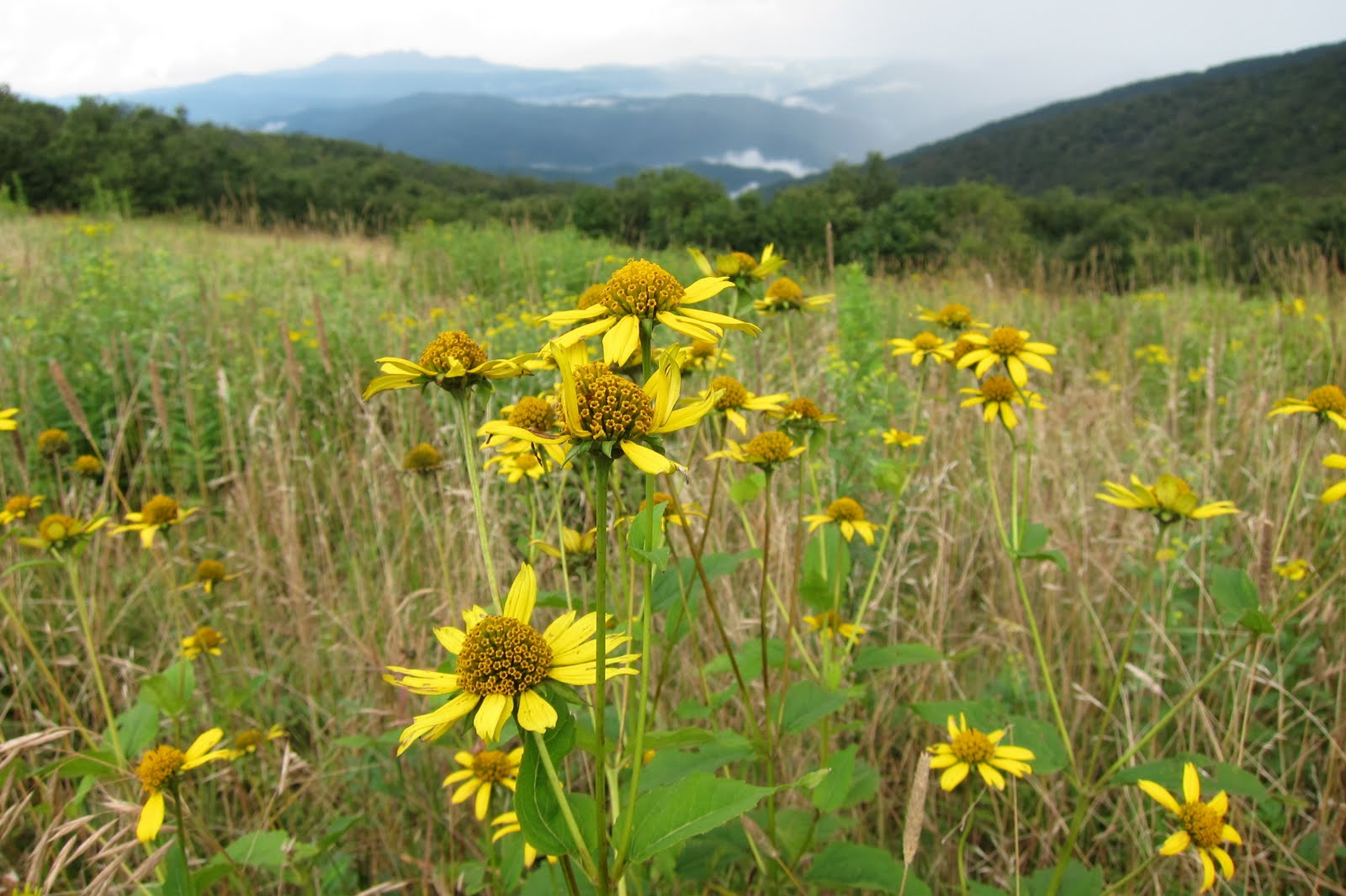
Gorgeous grassy meadows of wildflowers

When I began to read about all the unique plant communities in the Roan Mountains, I learned about all the threats this beautiful place.  In addition to usual risks to rare mountaintop plants like inbreeding, loss of habitat due to development or global warming, the grassy bald plant communities are at special risk due to the loss of natural forces that used to keep the balds tree-free (i.e. the extinction of the elk and bison and other large herbivores that once roamed these hills.  It is also possible Native Americans also may have helped create these places).  Now the balds will grow over with trees without help of volunteers, and introduced grazer like goats and steer.  I was also surprised to read that one of the primary threats for the federally endangered Roan Mountain bluet is "trampling."  This landscape of the Roan, with it's open vistas and grassy expanses, seems to invite exploration and romping off trail.  Could we hikers really trample a plant to extinction?  Does walking off trail really cause that much of an impact?

Apparently, scientists in the field of recreation ecology have been studying how recreation impacts protected natural areas (for an excellent review see Pickering et al. 2009).  They measure damage due to soil compaction, spread of weeds and plant pathogens, and changes in plant diversity.  They use a "hiking resistance index" to describe "the number of passes by a hiker required to reduce vegetation cover by 50%" for any given vegetation type.  Scientists do experiments where they go out and hike back and forth in different areas (for a wonderful description of this research with nice photos see this website).  They have found some plant communities are more fragile than others.  This is why it's so important to learn to follow the Leave No Trace principle to camp and travel on the most durable surfaces (i.e. dirt and rocks) and avoid sensitive plant community types.

Our nice already-established campsite
On this trip, I know we did the right thing in finding an already established campsite.  But looking at my own behavior, I realize that I don't always make such good decisions.  It's ironic that I take a lot of pride in making choices to reduce my carbon footprint during my day-to-day life-- taking the bus, driving a hybrid car, getting locally grown veggies from my CSA.  But when I go hiking, I bushwhack to discover new places, and I "stealth" camping when I go solo.  I don't know that I'll always stay on the beaten path, but I'm going to try watch my literal footprints more carefully and read more about ways to lessen my environmental footprint.

References
Pickering, CM, Hill, W, Newsome, D., and Y-F Leung. 2005 Comparing hiking, mountain biking, and horse riding impacts on vegetation and soils in Australia and the United States. Journal of Environmental Management 91: 551-562.