Thursday, February 13, 2014

PCT Planning: Why? and FAQs

People have been asking me questions about my upcoming hike on the Pacific Crest Trail, so I decided to answer some of them here.  If you have any other questions that I haven't addressed, please let me know.

Why do you want to backpack the Pacific Crest Trail? 
Backpacking is what I love.  Being outside is where I find meaning.  Many of you know I go backpacking (or hiking) nearly every weekend.  I never want to come home after being in the outdoors.   My room in town is more of a 'gear closet' than anything else.  I want to be immersed in the natural world.
At home right here on the trail. Photo by Sandi.
I also long to stretch my abilities.  Backpacking in the southeast on weekend trips is no longer difficult like when I was first learning to backpack.  I want to take my skills to the next level.
Water crossing with snow-covered banks in the Gila Wilderness.  I'm looking for more challenges like this.
I also want to add that I am seeking community.  I've met many of my closest friends while out backpacking, so I know how strong friendships can be forged in the outdoors.  I really hope that on the PCT, I will meet a wide variety of other backpackers- people who can teach me stuff, people with whom I can share outdoor experiences.  Maybe other people who understands what it’s like to have this crazy drive to go backpacking all the time.

Why the PCT?
I grew in Oregon, climbing trees and hiking and camping in the rain.  I've lived 'back east' for the past 20 years and I know the mountains and the plants of the Appalachian Trail better now than anywhere else.  Still, I miss being surrounded by snow-capped mountain peaks and being able to see "forever."  I miss the starkness of the high desert and the smell of juniper, sage and ponderosa pine.

For a while, I though I might choose the Appalachian Trail for my first long-distance hike.  It’s what I know- from living near DC and now in Georgia.  I already have supportive friends all up and down the AT.  Despite all this, the PCT is what draws me.

One quick story.... On vacation during college, I went hiking with my dad out to Crater Lake in Oregon, very close to the PCT.  We crossed one particular snowy traverse, stomping footholds in the snow.  I vividly remember feeling terrified that I might slip down the sheer drop-off.  I felt so small on that slope against the backdrop of the grander of the clear deep blue waters of Crater Lake.  When I think about why I want to hike the PCT, I always remember that sense of smallness that I felt, mixed with wonder at the natural beauty of the place, mixed with the sense of accomplishment for taking on such a physical challenge.  That's why I want to be on the PCT.
I've kept this photo of that snowy traverse at Crater Lake, OR on my desk for many years.
Why 2014?
When the funding for my research came to an end this year, I decided that instead of looking for another position, I would take the time now to do a thru hike.  I never took time off- I went to college right after high school, then went to grad school, then got a postdoc.  But I don't want to end up working non-stop for the rest of my life, or having to waiting until I retire, never having followed my dream. 

The other reason I'm finally doing it this year is because I was inspired by my friend Renee/Pathfinder who thru hiked the AT this year.  We had a long talk about choosing to do a thru hike in our mid-30's.  The majority of thru hikers are either right out of school, or retired.  People our age are settling down or having babies.  Talking to Renee alleviated my fears about stepping off the career-track and gave me inspiration to do what I want with my life.

How can you afford a thru hike?
I've been planning to "eventually" hike the PCT for a long time (even before meeting Renee).  Over the last several years, I’ve been saving up so I would be ready.  I think the most important thing I've done to save for a thru hike is to make backpacking a priority in my life.  I've made choices so that I can have the freedom and money to backpack-- no kids, no pets, and no home.   Rejecting notions of what society thinks success looks like has also helped.  

I’ve rented and lived with roommates for many years, but a few years ago I moved into an even smaller space with very low rent.  I also cut my other expenses considerably over the years- I don't go out to eat, don't drink, don't buy nice clothes, haven't traveled for a while, don't spend much money on my car or gas since I drive a civic hybrid, I get books from the library, cook my own food, sew a lot of my own clothes and gear.

I talk to some people who say they would like to thru hike, but just have too many responsibilities.  I think if you make backpacking a priority, you can find a way to do it.  For me, it is that important.

How do you think long-distance hiking will change you?
I don’t know for sure.  Possibly in ways I don't anticipate.  It might be the first in a series of long-distance hikes.  Or maybe I will finally settle down and be content with weekend backpacking trips.  Or maybe I will find a way to live outdoors more often or as part of a job, or in an otherwise sustainable way.

Isn’t backpacking a selfish endeavor?
(OK honestly no one has asked me this, but it's something I think about a lot.)
While long-distance hiking doesn't directly contribute to society, I think taking the time to do exactly what I want in life will, somehow, be a positive endeavor.

When I look back at the last five years, one of the most meaningful things I’ve done is to be involved with Trail Dames (a description of the group I wrote for the Gossamer Gear Blog is here).  I organize and lead hikes, and served on the Board, as my way to “give back.” I believe in the transformative power of hiking and connecting with nature, and I see so few other women out when I am on the trail- I want to change that.  It’s been so rewarding when women come up to me and tell me that I led their first hike and now they have gone onto hike tons more.  Or when someone tells me they recognized a flower (or saw tree foam) that I’d pointed out on one of my hikes.  It makes me so happy to facilitate those experiences, in whatever small way that I can.

Of course I know I haven't change the world by leading hikes, just like I know my hiking the PCT isn't going to matter in any big way to anyone else.  Instead, the biggest thing was how much my experience with Trail Dames has changed me- by teaching me to be more open and less judgmental, to be more patient- to slow down and savor experiences.   The most important lessons were ones I learned about friendship, trust, and about myself.  In learning how I could take advantages of my strengths, how I could make up for my weaknesses, and how I could work in a team.  In a similar way, I think that hiking the PCT will make me a better person, and will make me better able to have a meaningful life and inspire others.
Trail Dames also teach me how to have FUN. Photo by Monica.

Tuesday, February 11, 2014

Down the Congaree

This was the type of trip that is intensely satisfying to look back on.  I can laugh about it and think, "Wow, we did that!"  But in the moment— it was HARD.
It took days of paddling and countless portages to finally make it to this gorgeous sunrise.
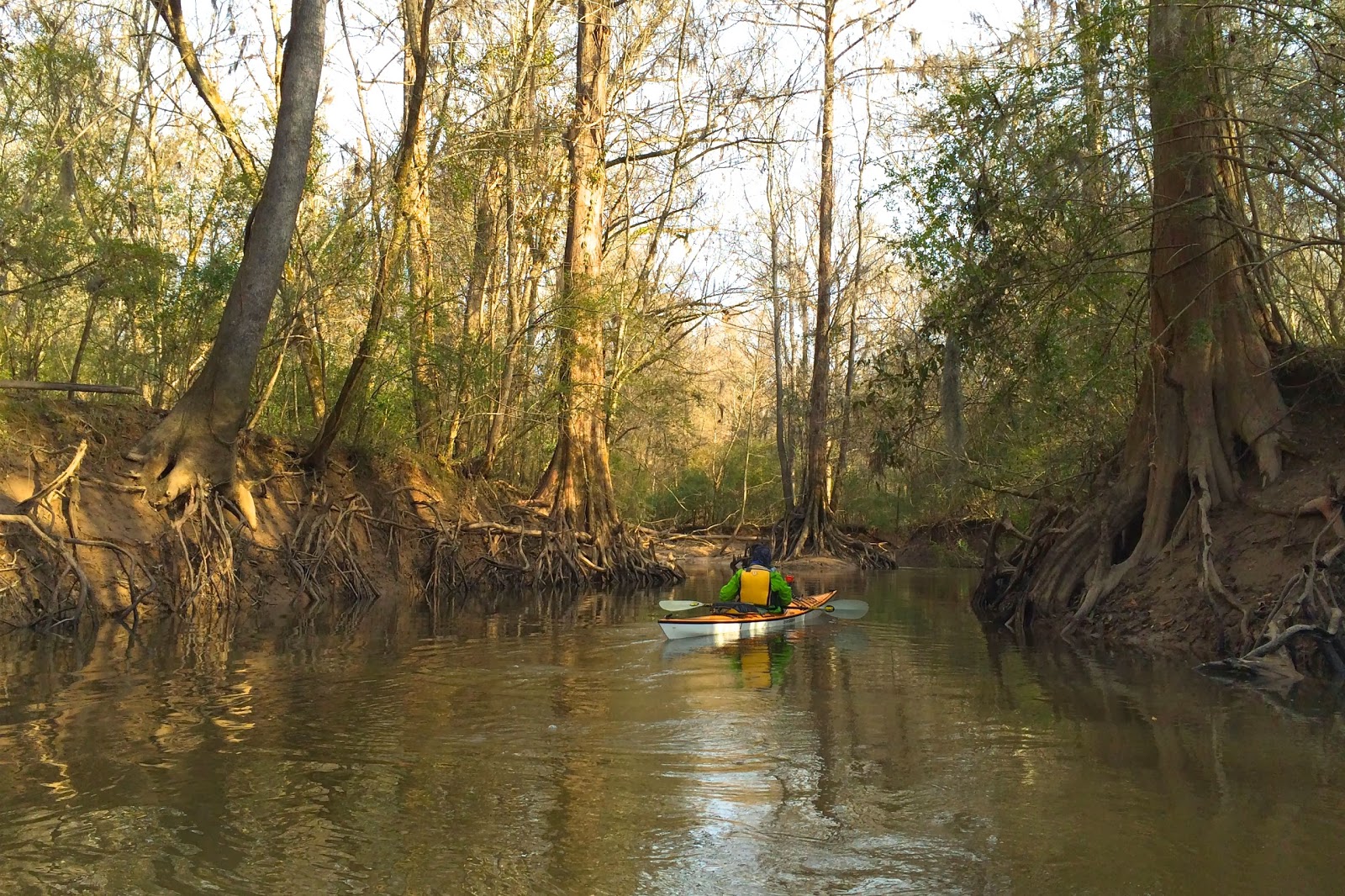
My friend JJ and I went for a 4 night/5 day kayaking trip on the Congaree River “Blue Trail” for about 40 miles from Rosewood Landing near Columbia, South Carolina, then up Cedar Creek through Congaree National Park for another 7 miles.  (see JJ's trip report at JERMM's Outside)
Thick mud at the put-in should have been a warning.
The first day was peaceful being out on the water.   A sandbar campsite, the chorus of crickets or frogs, and then coyotes calling back and forth across the water.
Sandbar on the Congaree River.
Three things took this trip to another level.  It nearly reached type 3 fun.

First there was the rain and freezing cold.  I couldn’t manage to generate enough heat while paddling to stay warm.  My glove and shoe systems, sufficient for backpacking, were not adequate for the cold-weather kayaking, and my fingers and toes were numb for much of the time.  I believe that comfort is not the point of an adventure so that's not necessarily a problem, but I also know it takes its toll, sapping energy, and can quickly lead to hypothermia.
Paddling in the rain and cold.  Photo by JJ.
Even with the cold, it was still fabulous to be paddling day after day.  Watching the tree-lined banks passing by, seeing more birds, and the bright red buds of the red maples (spring is near!).  It was also heavenly to end each day hanging in my hammock, wrapped in warm down quilts, toes finally thawing out (what a treat to be able to feel one's toes!), listening to raindrops on the tarp and later the owls and woodpeckers and other wild creatures.
Resting in my hammock.
 The second thing that happened on this trip was that I got more sick than I’ve ever gotten while out in the backcountry.  On the third day at lunchtime, I told JJ I felt like I couldn’t paddle any more.  So we called it a day and I collapsed into my hammock.  Fever, nausea, likely dehydration, total lack of appetite.

 The cool thing was that I learned that I could actually recover OK out there.  My hammock is the ideal place to rest, so by the next morning, I got up ready to paddle.  I was really low on energy and unable to eat much for the duration of the trip, but I found out that I could still manage.
Downed trees across Cedar Creek- time for another portage.
The final thing that really took this trip to another level of difficulty were the downed trees across the creek that we had to portage around on the last pull up Cedar Creek.  There were so many that I lost count.  It ended up taking us one and a half days of hard work to reach our car at the Cedar Creek Canoe Access.  For a "paddling" trip, there was a lot more sloggy through the mud carrying heavy kayaks than we bargained for.
Hauling the kayaks up and down steep muddy banks.
Working that hard, life takes on a intense focus.  Everything is totally in the moment-  one foot pulled out of the mud (that mud had some strong suction!), next step a few inches up the bank, then lift the kayak up, then set it back down (gently!).  Never thinking of anything not immediately of concern. 
JJ figuring out how to move the kayaks efficiently up the creek.
Even though it was tough going, the overwhelming beauty of the area, plus the fabulous company, made everything worthwhile.  Cedar Creek was absolutely gorgeous with cypress knees, colorful lichens on gnarled and ancient trees, woodducks and great blue herons.
One last surprise...  On the last night, nearly asleep, I heard a voice out of the darkness.  It was JJ.  Would I like some hot soup?   It was quite possibly the most delicious soup I’ve ever tasted!  I hadn’t been able to eat much all day, but that soup completely hit the spot.  Ahhh, bliss!
BEST SOUP EVER!!!!
Overall, this was a really satisfying trip and I'm so glad to have "survived" it- we got to see some really inaccessible places and see lots of wildlife and birds, and we MADE IT! 

For more information:
Congaree River Blue Trail - NPS map and more info here.

Congaree National Park- pick up your free backcountry camping permits before you head out.  The Cedar Creek canoe trail is only partially marked, and has numerous portages right now, so I wouldn't recommend doing the trip we did.  The rangers said that they try to clear it once a year, but there are funding problems so call ahead (also ask about flooding and weather/ bugs/ snakes).  Or, stick to the hiking trails which were fabulous and that I enjoyed a lot on a previous trip to see the big trees.

Sunday, February 2, 2014

PCT training: knee problems and aerial dance

My plan when I was started preparing for the PCT was to focus on physical training and injury prevention.  To get into “the best shape of my life” before starting.  

I read books about exercise- Chi Running and Fix your Feet.   I set out a training plan involving gradually increasing my distance and pack weight, and doing specific exercises to targeted at my hiking form. 


Knee problems
Despite my efforts, around New Years, my old knee pain (IT band problem) returned.  I overdid it by hiking too fast with too much weight than I was probably ready for.  (oh, I miss my lightweight pack!)  Since then I've reduced the weight I've been carrying to 15-20 lbs, so it doesn't hurt.  However, doubt at my physical ability had hit an all-time high.  What if the only reason that I've always felt so strong as a backpacker is because my pack weight is light?  When I carry a heavy pack for the long water carries on the PCT, could I get too injured to hike?

Fortunately, I’ve had other things to keep my busy….  preparing for another aerial dance show (i.e. dance trapeze and aerial silks- sort of like Cirque du Soleil- only at an amateur-level).  I thought this might give my legs and feet time to heal.  Ironically, all the aerials practicing left me exhausted and ever more sore.  It doesn’t seem like rest climbing the silks over and over, or when I am walking around with my pack at 6 AM.

Why I'm so sore- climbing up and down and up and down.
In-town hiking in the morning.
Lessons from trapeze and aerial silks
I've learned a few lessons from getting ready from our aerial performance that I hope will help me for the PCT. 
From doing aerials, I learn that soreness is part of the process, and is a physical sign that I am getting stronger, but I also learn how to not push it too far.  I stretch, I rest, I do exercises to improve my form, then I go back to practice. 
Massaging my sore forearms.
I learn to listen to my classmates and teachers when they tell me that I am strong enough to do a trick, when I don’t believe it myself.  It always turns out they are right.  I think about this when one friend tells me "I have no doubt in you completing the PCT in a thru-hike.” 
 Photo by Susan.
This show was the most challenging one I’ve ever done-  the cues were tricky, there were two transitions that I only get ‘right’ 25% of the time, and there was little time between our two pieces to rest my forearms.  When we first choreographed our aerials piece, I didn’t know if I would ever have the strength to make it through the entire set of tricks.  A few times during practice, I’d have to climb down, unable to continue, my muscles spasming.  But I knew my classmates believed in me and that arms have never been so strong.  Sure enough, we totally pulled off an awesome show!  I hope I will be as strong for the PCT.  I poke at my rock-solid forearms wondering if those muscle cells can please migrate down to my legs.

When I look down at my hands and see my callouses, I know I have the hands of an aerialist.  I realize… I AM an aerialist!   I practice saying "I AM a PCT thru hiker” and can hardly believe it will become true in another 2 months.  
The final performance goes really well!  Photo by Susan.

Wednesday, January 29, 2014

Packing and Resupply for the PCT

I am moving out of my current home and putting everything into storage with friends and family while I go hike the PCT .  My roommate is selling her house, so I need to pack up now and move a little over two months before I fly out to San Diego to start hiking.  I’ve been sorting resupply boxes, prepping for a couple “training” trips, doing last-minute sewing and gear projects, and organizing all my stuff.  I’ve downsized quite a bit the last few years, so it all fits into the room I rent in my roommate’s house, plus a few kitchen items and work books and papers-- but still, it has taken me a while to pack since I like to get rid of stuff every time I move.  Friends have been helping me out which has made this whole process easier.
Still Waters helps me sort and label my spare gear so I can keep track of it.
Labels on my spare hiking clothes. Can you tell I'm undecided about clothing?
Labels on my spare gearSome of it I don't use anymore, but I hold onto it "just in case"-- sigh...

Putting stuff into storage
I am going to distribute my stuff (both my gear and my non-hiking-related possessions) between my parents and four of my friends here in Georgia.  My folks offered to keep all my stuff at the house in Wisconsin (which is where they retired to), but since I doubt I'd want to live there, I am just giving them my "valuables” to store- photo albums, rugs, and a few pictures.  I don’t know where I’ll end up after hiking the PCT, but keeping my other stuff (i.e. my clothes, sewing supplies, books, and kitchen supplies) mostly in Georgia with my friends just feels right.
Things my parents will store for me: portrait of Darwin, and prints drawn by my grandma of Mt. Hood and the Oregon coast.
Resupply boxes
Because I am moving soon, and will be living out of my suitcase and backpack after that, I’ve gotten most of my resupply boxes together already.  There are various ways to get food along the PCT, and I am choosing a mix of strategies.  I cooked and dehydrated my favorite, homemade no-cook meals for about 7 resupply boxes, most of which I'll supplement with snacks I will buy in towns.  Still Waters has generously offered to send 5 resupply boxes to me at various points in So. Cal and the Sierra.  Then, in larger towns I’ll buy all my food for my resupply.  I will also box up and ship food to myself to places that don’t have good selections- like some places in Oregon and Washington. 
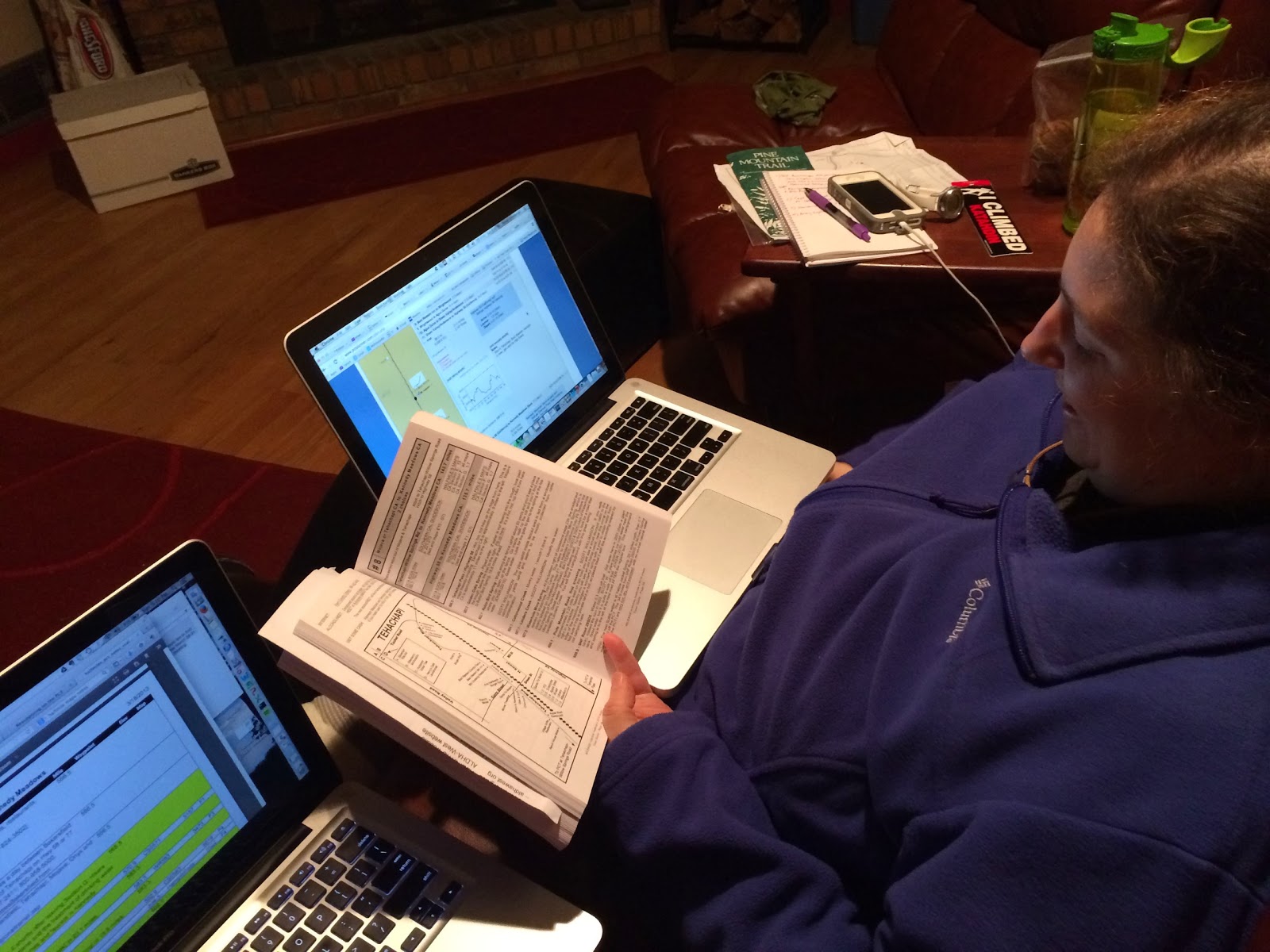
Renee and I used Craig's PCT planner, Yogi's guides, and Halfmile's notes to get rough estimates of our resupply stops and how much food to send or buy.
Sorting my homemade, just add cold water meals into resupply boxes.
My parents- meeting me on the trail
My parents are also going to be visiting me a few times while I'm on the PCT.  They love to hike and travel, and I think my dad especially would join me on the trail if he could.  But meeting me at trailheads and in towns will be a wonderful way for them to share the adventure.  They plan to meet me in So. Cal. before I head into the Sierra, then again in Nor. Cal, and then Oregon.  They will travel and sight see on their own and then meet me, helping us resupply, then taking us back to the trail. (Note: if anyone has suggestions for places for them to stay near the trail that are scenic and uncrowded especially in Nor. Cal., please let me know!)
  
They are driving down to Georgia this weekend to pick up “spare gear” and 2 resupply boxes (mostly dinners I dehydrated).  I am giving them my warmer clothes for the Sierra, rain gear and passport for Washington (the Canada entry permit is being mailed to them so they can get that to me as well), a couple plant identification guidebooks (yay!), and extra stuff for gear repairs and replacements.  I have no idea if I'll need any of this spare gear, or how easy it would be to otherwise pick this stuff up along the way, but since I already have it, I figure I might as well give it to them.

My parents have been doing some preparations of their own, looking over maps, and they both finished reading "Wild."  We've had some wonderful trips in the past so I know that having them out there will be really fun.
Dad suggests foraging for edible plants to supplement my diet on my thru hike. <haha!>
Mom says to find good, strong trees like this one for hanging my hammock.
Final thoughts...
It has been an interesting process to try to figure out how to share my journey, to plan for how I will get support.  Often, I find it difficult to ask for help (finding it much easier to help others, much harder to receive help).  In the past I was drawn to the self-sufficiency of backpacking, to the concept of carrying everything needed and nothing more.  One of the things that's becoming more clear to me is how wonderful and important my connections are- people care about me, and they also believe in and are supportive of 'living the dream.'  I am learning that when people help me, they become part of a shared experience that enriches all our lives.  I expect I will continue to learn more about this part of long-distance hiking.

Thursday, January 23, 2014

Bushwhacking to hidden waterfalls

I'd had been intrigued for several months about this one particular trail along the Blue Ridge Escarpment in South Carolina that I could not find out much about. There are typically two reasons for a lack of information in guidebooks and online reports about a placel- either it is (1) not noteworthy enough to warrant space, or (2) a well-kept secret.  I made some inquiries, and learned this area had a "treasure trove of waterfalls"  that weren't marked or on the main trail.  There were also some warnings-- "some seriously steep terrain”….. "evaluate risk/safety issues”  ….  “full-contact bushwhacking”….  Oooo!  FULL-CONTACT-BUSHWHACKING!  My kind of place!

Off-trail travel
I set out on a solo backpacking overnight.  When I headed off-trail in the direction of the waterfalls, I had to negotiate my way over blowdowns, briars, and icy patches.  I was glad I'd kept my pack relatively light (in contrast to the last few months as I've been trying to carry more weight to prepare for the PCT).  I really appreciate the high level of engagement required for off-trail travel-- getting to read the landscape to find your own path.  There are still false starts and backtracking, so the going can be slow, but this trip wasn't about covering miles or winning any speed records.  
How will I get down there?!?!
Oh my, how will I get down there?!?!
I knew I was close when the terrain got steep and I could hear the deep roar of the falls echoing across the valley.  That's also where I found what distinguishes "full-contact bushwhacking" from regular bushwhacking--  fingers grasping at the dirt and mud, skooching on your belly down the cliff, reaching for footholds, awareness of the pull of gravity.  Feeling small and insignificant, and yet, interconnected and part of nature.  In essence, totally alive.
What a gorgeous waterfall!
Another hidden falls!
The valley of hidden waterfalls was incredible beyond description.  There were few signs that anyone had ever been there- and no signs anyone had been there recently- no trash, no footprints, no cleared or broken branches.  My photos just don’t capture it, but maybe you can tell from my expressions just how awesome and wild it was.  Finding them felt like an exhilarating discovery.  Or maybe it was just the endorphins.
Yet another!
The value of wild places
If I saw a falls like this from an established trail, it wouldn’t spark such enthusiasm. 
Sure we need accessible trails, but we also need trail-less areas and places that aren’t on the maps.  The idea of building a trail or boardwalk to these falls makes me cringe.  Their beauty was exceptional precisely because of they were difficult to access.

Places like this that are mostly untouched capture the imagination.  For daydreaming when I'm stuck in a city.  For keeping me excited about new places.  For keeping my eyes and ears peeled for hints of what lays beyond the edge of view.  When I'm heading down an established trail and hop across a little babbling stream, I can imagine that a few hundred feet down, joining other streams, there are falls tumbling into a waterfall valley of wonder.

As I crawled my way back up the cliffs, I did my best to try to not leave even footprints (easier in theory than in practice!)I didn't want to rob the next person of the feeling of going out into uncharted territory (also this article on LNT and bushwhacking).

So... you may have figured already that I am not going to tell you where this exact place is.  The important thing is knowing that it's OUT THERE.  If you need to go somewhere like this, I am certain you can find it, or something like it.
Saved the biggest falls for the next morning.
It really did get cold overnight- forecast said 15-degrees.  Look at the ice!
Notes and resources:
Here is where I normally tell you the maps and guidebooks that provide info on the route.  Instead, check out these inspiring books:

Desert Solitaire by Edward Abbey
          -My all-time favorite book.  Inspiring and irreverent.  About many things including our relationship with nature.  Will make you want to visit Utah and the southwest.

Backwood Ethics by Laura and Guy Waterman 
         -Includes chapters are on fires, thru hiking, bushwhacking and the history of Leave-No-Trace (LNT) ethics.  This book explains the variability in why people get out and the benefits of different approaches- especially helpful when trying to figure how we can all get along in the backcountry. 

Listening for Coyote: A Walk Across Oregon's Wilderness by William Sullivan     
         -Sullivan made his own path across Oregon and writes about his journey and the interesting people he meets, and mixes in views on wilderness and land use.  Inspiring!

Monday, January 13, 2014

Winter Backpacking Food Favorites

I’ve mentioned before that my backpacking menu changes with the seasons (my summer favorites here).  In winter, flavorful and hearty meals taste good in the cold.  I like to adapt dishes that I normally eat at home for the trail.  This works for me because I cook (most of) my meals from scratch using seasonal veggies when possible.  When I cook my dinners for the week, I often make a double batch so I can put half on the dehydrator.  Stews and curries are especially satisfying and dehydrate well.
Rehydrated by adding cold water.  Doesn't look like much but it was delicious!
Here are a few dishes, with links to the original recipes, that I’ve cooked and then dehydrated this winter (details and photos below):
     Curried red lentil stew  -hearty and satisfying.  I doubled the spices.
     Roasted vegetable soup  -roasting the veggies enhances the flavor.  I omitted the white beans, and sometimes substitute sweet potatoes instead of squash.  One of my favorites!
     Moosewood mushroom curry -a tad sweet and tangy. I doubled the spices here too.  I also dehydrated jasmine rice to go with it, and topped it with unsweetened shredded coconut.  When I make it for home, I like adding tofu, but tofu takes longer to rehydrate so will omit it next time.

At home
I cooked these recipes using less water and half the oil which helps for dehydrating.  Be sure to cut everything up into small chunks.  The recipes are very forgiving so feel free to make substitutions.  The important thing is the rich flavor, and adding plenty of spice.   Spread them thin on the dehydrator trays to dry overnight.  Then once they were totally crispy, I repacked them into ziplock freezer bags and added some freeze-dried chicken.  
Roasting the veggies for soup
Cookin'
Red lentil curry is done when it is brittle and crispy.
On the trail
I still go stoveless (yes, even in winter!) and these meals rehydrated in less than 4 hours with cold water.  I just  eyeball how much water to add to reconstitute my meals, but it’s a good idea to check to make sure you added enough water about an hour before you want to eat, just in case it was an underestimate.  Stews are forgiving because if you add to much water, its just more soupy.

I keep the rehydrating meals in the "warming" pouch of my hoodie (i.e. the front pocket) when it is below freezing to help them rehydrate and to prevent them from freezing in my pack (or thaw them if they already froze in my pack cause I didn't realize how cold it was out!).  I made sure to double bag them or put them into an opsack to prevent them from spilling all over my clothes.  Sure glad I didn't meet anyone out on the trail because this is what carrying dinner (plus my water) in the pouch of the hoodie looked like...
Rainpants complete the look.
Of course you could just take a stove, and then just do the freezer-bag cooking method of just adding boiling water and allowing it to rehydrate in your pot cozy for a short while.

Protein
I’ve also been experimenting with various protein sources, and I found that adding freeze dried chicken to all of these dishes was easier than cooking them with added chicken, and then dehydrating that all together (I tried it both ways).  The freeze dried chicken soaked up the flavor quite nicely and reconstituted well in cold water.  But if you can't find the freeze dried stuff on sale, either way works fine.  

I also add freeze dried cheese to various dishes like chili, and it also fully hydrates in cold water.  Of course there is also no reason not to carry fresh cheese when the weather is so cold.
Freeze dried cheese added to a dinner, then vacuum sealed (for longer storage).
And for afters...
Having extra calories right before bed helps me stay warm over the course of the long dark nights of winter.  Look for higher fat instant pudding like this “Greek yogurt” style and mix it with some Nido milk powder.  Then in camp, just add cold water (don’t add too much- add it little by little!), stir or squeeze the bag vigorously, and it will set quickly (especially in the cold).
High calorie dessert to stay warm
I also make my own version of pumpkin pie pudding by making pumpkin “bark” (see recipe from Backpacking Chef).  I run the bark through the food processor to turn it into a powder because that allows it to rehydrate faster.  A scoop of protein powder, some dried coconut, and almonds also increase the fat and protein content for longer-burning fuel, which really help me stay warm at night.  Great excuse for desert!
Making the pumpkin pie pudding

Friday, January 10, 2014

Shakedown #2: Bear Canisters & Gear Minutiae

Renee (Pathfinder) came down to Georgia over the holidays for another shakedown trip for our Pacific Crest Trail thru hike (our previous shakedown trip here).  Neither of us had previously carried our bear canisters packed with 6-7 days of food, but we wanted practice for when we get into the Sierra.  We were joined by Susan who is hiking the PCT as well (YAY!).  Susan was the trip leader on my first backpacking trip with Sierra Club, is a fellow naturalist/ salamander hunter/ wildflower enthusiast, and is all-around AWESOME.  I’m so thrilled the three of us will be starting our PCT adventures together in only 3 months!
Susan, me, and Renee/Pathfinder.
Our route
This "practice” trip for the PCT, ironically enough, took us to the terminus of the Appalachian Trail (AT) in Georgia, starting at Amicalola Falls State Park up to Springer Mountain (with a visit with Hammock Forum friends- nice to see you guys!), and then north to Woody Gap.  Due to winter weather, we then headed to lower elevations on the Chattooga River Trail near the South Carolina/Georgia border to continue our trip (out and back between SC 28 and Sandy Ford Rd).  (Thanks again Kellye for the weather advisory and ride!!!!)
Susan and I on Springer Mountain on New Year's Eve.
The Chattooga River near Dicks Creek Falls was plenty cold- it still got into the low 20's.
Bear-can-love
One of our goals for this trip was to practice carrying bear canisters.  I recently bought a bear canister (BV500) for my PCT trip, and though I’ve been shlepping the bear canister around (here and here), this was the first time I’d tried packing it with six days of food plus the first day’s food outside the canister.  While bear canisters are required on certain parts of the PCT, using them in Georgia is quite uncommon, and they are only recently required here (i.e. on the AT near Blood Mountain during thru hiker season).
Trying to get all the food into the canister.
Adjusting to carrying the bear canister involved several steps- figuring out how to repackage and organize food in the can, and select more calorie-dense food, rearranging all my other gear in my backpack with the canister (the bear can is bulky!), getting used to how the backpack feels on my back with the canister (it’s very heavy!), and learning how to open the canister when it is cold (use this card opener method).  Learning these skills BEFORE I am out on the PCT will hopefully allow me to better enjoy being out there in the gorgeous scenery rather than fiddling (as much) with gear.
Reflective tape for finding the cans in the dark.
I’m a total convert to the bear canister!  It saves time not having to hang the food.  With the short winter days, I don't have the frustration of throwing the bear line in the dark.  While I’ve gotten much faster at hanging my food and never had critter problems, my food hangs have been less than textbook a few times-  due to things like branches falling down, camping in pine forests with no reachable horizontal limbs, getting line stuck in the tree, or in dark/ rain/ dense fog.  A bear can eliminates the time spent on bear-bagging misadventures.  And most importantly, the bears (in the Sierra) won’t eat our food and then become problem bears- or dead bears.
Huddled under my tarp on the AT.  Probably the only bear canisters and umbrellas around for miles.
From gear angst to gear minutiae
You might recall that our first shakedown trip two months ago involved high levels of gear angst.  We were worrying about changing our gear for the different conditions we anticipate on the PCT.  We were struggling with the awkwardness of new gear (i.e. our packs, lighter shoes, electronics) and trying to be open-minded about change. 
Playing around with our water systems.
Two months later, we finally made it to the point where we decided to keep the gear we've loved on the AT (making some adjustments of course), and we have largely transitioned to a new stage which we jokingly call "gear minutiae."  Little trivial changes.  We have most of our gear to start the PCT, and yet, we can't help but try to improve, streamline, and optimize.  Cut an ounce here and there.  Platypus big zip vs. hoser?   In-line sawyer vs. sawyer squeeze?  Icebreaker 200 vs. 260 weight long johns?  Do I gotta get a new buff because my old AT buff would be totally dorky on the PCT?  ... seriously... none of this minutiae will make or break our PCT experience.  But it gives us somewhere to channel our ridiculously bubbling-over, out-of-control excitement.

Is it time to start hiking the PCT yet? 
We're feeling (almost) ready.

Obligatory photo of lovely, glimmering, tree foam!  Woo hoo!