Friday, September 9, 2011

Fears: Bears

Bears are one of the things that scares me the most in the outdoors.  And I know I am not alone in my fear.  I've spent many hours lying awake at night trying to figure out if the rustling I hear outside is the wind, or if there is a bear outside about to tear through my tarp with its sharp teeth.  Yet, I've never had a bad encounter with a bear, and I know injury from bears is extremely rare.

On our trip up Gregory Bald in the Smokies over Labor Day, my hiking group and I encountered a mother black bear and her two cubs right on the trail (for a description of our trip see Sandi's excellent trip report).  I felt really scared at the time, but what I learned during the experience helps me feel less afraid. 
YIKES! There's a bear up there on the trail!
What is fear?
Fear is something you feel in response to a perceived threat.  When fear is in response to a real physical threat, the fight or flight response that takes over can save you from danger.  But fear can make you act irrationally when the danger is really all in your head. 

In the case of the bear on our trip, I knew this bear wasn't a real physical threat to us.  Fatal black bear attacks are exceeding rare (Since 1900, there have been only 45-recorded deaths that were caused by black bears in the North America).  Most (90%) fatal bear attacks involve only one or two people (and we were in a large group) and most (92%) involve male bears (and our bear was a female).   Given these statistics, my reaction was a result of the stories I was making up in my head, rather than the reality of the situation and the facts.

What to do when you are afraid
The best advice I've heard about what to do when you feel fear is to (1) take stock of the situation, and then (2) take steps to get out of danger. 

To "take stock", our group stopped to watch the bear for a long time.  All the other black bears I've encountered have run off far away immediately, but this case was different.  Still Waters figured out that this mother bear had her cubs hidden up a tree.  The bear walked over to the base of the tree where her cubs were, and we could see that she was refusing to leave the area. 

We decided to literally take steps around the bears.  Rather than continue on the trail towards the mother bear and her cubs, we stepped off down the hillside and made a large circle around the bears. 
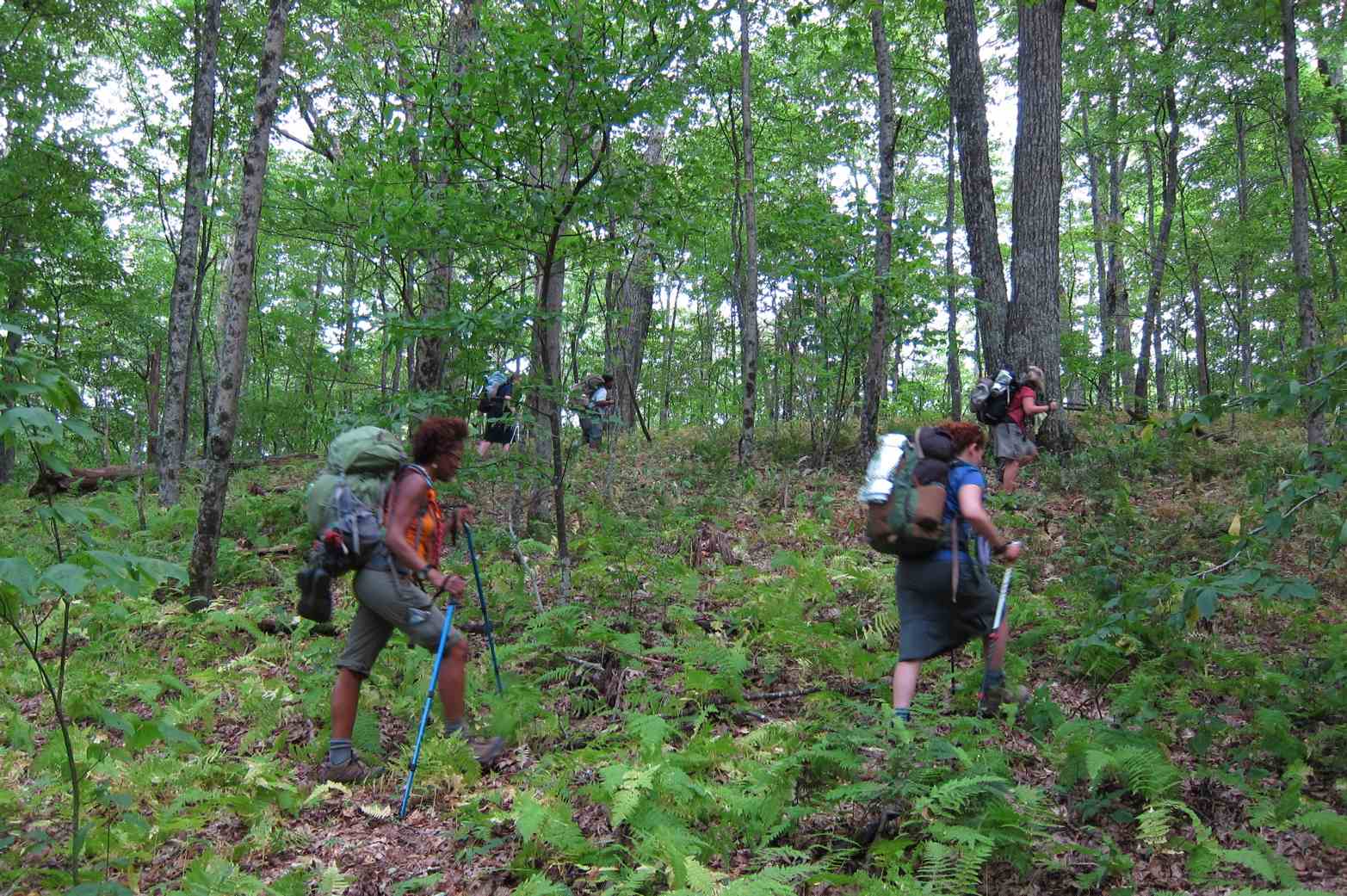
Walking off trail around the bear in a wide arc
Becoming less afraid
Since bears don't pose much of an actual danger, how do I become less afraid?  The steps to take to overcome fears involve learning the facts about the danger and exposure to the thing you are afraid of.  One thing that really seems to work is making up new positive stories about bears.  This is my own version of the "Riddikulus" spell from Harry Potter.  To defeat the scary-Boggart (creatures that take the form of whatever scares you the most), the Riddikukus spell transforms the Boggart into something humorous, thereby making them harmless.  For example, Ron is scared of spiders, so he defeats the Boggart by imagining it as a spider wearing roller skates to make it silly.   I picture us laughing as we walked through the land mine of bear poop to get around the bears.  I also picture the memory Still Waters as "Bear Whisperer" talking to the mother bear in a gentle voice.
  It's hard to be afraid with sweet memories like that!  With each bear encounter, I become less afraid.

Remembering to respect wildlife (including bears!)
While I can't say I really "like" bears, I respect that the forest is their home, and that I'm just a visitor in the wilderness (as much as it feel like home when I'm out there).  I understand that giving animals their space prevents them from becoming habituated or stressed.  (Leave No Trace principles say that you know you are too close to a wild animal if it changes her behavior.)   I also appreciate that bears play an important role in decomposition (Just imagine where we'd be without decomposition... up to our ears in old icky dead things!).  Bears also disperse seeds and berries (Thank you for spreading around berries for everyone to enjoy!).   As someone who really loves plants and wild places, I am happy to be in an ecosystem that has bears.  But I honestly, I'm still happy if all I see of their presence in the wild is their poop.

To learn more about bears:
http://www.bearsmart.com/media/1194

Friday, September 2, 2011

Carrying less

"The less you carry, the more you'll find" -Garlic

On my first backpacking trip, I carried 35 lbs. of stuff that all seemed absolutely essential for my safety and security in the (scary) wilderness.  Two years later, my pack is ten pounds lighter.  How, and more importantly WHY, did I make these changes?
On my 1st trip with a huge tent and 35 lbs of stuff.
Going lighter-weight gives me more energy to do the things I love-- investigate flowers and explore side trails-- because I'm not worn out hauling around lots of stuff.  The extra gear I didn't use cluttered my pack.  Now, I feel free when I moved more nimbly down the trail with my lighter load. 

Skipping through the wildflowers near the North Rim of the Grand Canyon.  This is what it FEELS like to carry 23 lbs.

Let's get to the "how."  Each trip, I try to leave some carefully-chosen item out of my pack.  Then, I find out if I miss the item, or what I can make due without.  I learn WHY I take an item, rather than WHAT piece of gear I choose.  This type of controlled experimentation has show me I don't miss:

1. My stove.  No-cook meals involve less fuss and can be eaten immediately.

2. Extra clothes.  I now hike in one set of clothes (my "dirty" clothes), and sleep in my long-underwear (my "clean" clothes). 

3. Camp shoes.  I now air out my barefeet at rest breaks. My hiking shoes are so comfortable I don't need to walk around in anything else.

4. Long pants (in everything but the coldest weather).  I love the breeziness and easy peeing of my hiking skirt.  Gaitors keep my legs warm and protected.

5. My tent.  I used to take comfort in the protective cover of my tent, which created the illusion of security.  I've since embraced the open view of my surrounds offered by my hammock and tarp.  It makes me feel more connected with nature and I sleep soundly off the ground.

Finding what items I was OK with leaving at home (and what I found essential) helped me to understand my individual style of backpacking.  It clarified, in essence, WHY I backpack.  The less I carried, the more I found out about myself.

Sometimes my experimentation showed me what items I should keep in my pack.  When I left behind my camera, I learned that taking pictures is something I do as a way to focus my observations and see the beauty of nature.  Having a notebook in my pocket and writing down my nature discoveries and my thoughts helps me clear my mind, and without it my brain felt cluttered.  My steripen allows me extra flexibility.  I drink instantly when I reach a spring and "tank up" by drinking an extra half liter at to rehydrate, rather than having to wait 30 minutes for the chemical treatments to work.  When I forgot my underquilt (oops!), I realized that I could stay warm enough (in summer) by using my pack under my torso as insulation in my hammock.  But I also really appreciated being surrounded by the soft cozy down of my underquilt, and I realized the huge difference a good night's sleep made in terms of how much energy I had for hiking. 

Overall, I've learned that what brings me the most joy while backpacking is the hiking part of backpacking (rather than the camping part).  Other people tend to enjoy the camping part of backpacking, and the items that make them comfortable in camp.  Some people really like backcountry cooking, so they would never be happy without their stoves.  The key thing is finding out why *you* backpack, and then consciously making gear decisions that enhance your enjoyment of the outdoors.

**Disclaimer-- I also totally admit I have the money to buy (or sew) the gear that I want.  I've been extremely lucky in terms of my family (and thus socioeconomic status), eduction (thanks Mom and Dad!), and my ex (who seriously is the best ex ever!).  But I've also made tradeoffs-- i.e. cheap rent, fuel-efficient hybrid car, no kids.  The point of this article is that some things that are helpful in backpacking are not what you HAVE, but what you DON'T have.**

Wednesday, August 31, 2011

Knee Pain

**Warning: I've avoided talking about my knee pain, but I'm posting this now in case it helps anyone else.   Other people's health problems are by definition boring though, so feel free to skip this post.***

"The pain in your knee is caused by your alignment," the Physical Therapist explains as he points to the video he's just taken of me on the treadmill.  "The problem isn't your knees, it's the overpronation of your feet combined with your pelvic alignment.  You need to change your hiking form." 

I stare at him blankly.  This is not what I expected to hear.  I thought I had bad knees, would be prescribed knee exercises, or told I'd need surgery.  My biggest fear, and why I'd put off going to see a doctor since May, was that I though I'd be told to stop hiking.  Could it really just be my alignment?  Seriously?  But there it was on the screen, my knees bent inward at an awkward angle, which he explained caused the knee cap to wear away at the bone instead of riding nicely in the groove (this is called "runner's knee").

After a lesson in biomechanics and anatomy, I was sent home with a series of self-correction exercises and stretches for my hip joints to do several times a day, and instructions on how to change my posture and form while I hike and run.

Focusing on keeping my knees in alignment
Last weekend, I tried it out-- a few exercises on the picnic table at the trailhead before the hike, and then every step, trying to remember to keep my butt squeezed and chest up.  The result was no pain on my 18 mile hike!   Or at least no pain in my knees.  My butt was another story! Those muscles were sore from being worked in new ways.

In retrospect, I don't know why I was so surprised that form and alignment mattered for hiking.  Alignment is so central to other types of movement that I do-- in trapeze and aerial fabrics class, our teachers constantly stress proper form.  In fact, my trapeze instructor always urges us to keep our chests open when we are doing certain tricks.  "Show your necklace" she calls it.  This sounds very similar to the instruction from the PT, who says to lead with you chest instead of keeping your head down.  Anyway, I am excited to bring that same body awareness to my hiking now that I have gotten some direction about how to improve my form.  Concentration on form is something that is a wonderful mental exercise during trapeze, and it forges a mind-body connection that is especially calming.  When I direct my attention towards keeping my body moving in a precise way, really feeling the movement, it changes my relationship with my own body.  When I concentrate this way in trapeze on my form, it is just about the only time when I actually feel beautiful and happy with my body.  Rather than pounding out the hike and throwing myself down the trail, I want to try this new way to be more gentle with it, coax it into place, and see if I have a shift in mental alignment as well.

Showing the necklace

I'm still waiting to see what happens when I go backpacking this weekend, but I'm hopeful that changing my alignment will help stop the pain in my knee.   If any of you out there have pain in your knee, I really encourage you to stop ignoring pain and get it checked out!

Monday, August 29, 2011

Gear Review: Dripping Water Collecting Device

On hot August Georgia days, it's a challenge to find water on ridge-top trails.  Many springs are reduced to tiny trickles which flow drop by slow drop from mossy covered rocks into large mud puddles.  Catching the drops in the relatively narrow mouth of a nalgene would take a long time because the mouth is so narrow compared to how dispersed the droplets are as they seep down the rockface.  What's a thirsty hiker to do?  

My favorite gear for such instances is my Special Super-Wide Dripping Water Collecting Device.  It's ultralight weighing only 0.1 oz and made out of ultra-thin plastic, attractively decorated with colorful and informative print.  It has an extra large area for collecting droplets of water-- nearly 5 times the collecting area as a wide-mouthed nalgene, so fills up 5 times faster!  Collect as much water as you need, then pour it carefully into your bottle to purify.  When you buy it at Wal-Mart, it's only $2.18 and comes with 8 tasty tortillas (be sure to remove these from the bag before use).  As with all of the best gear, it also has a dual-purpose and is large enough to store wraps for your lunch.
My Dripping Water Collecting Device came in handy on the Bartram Trail
Disclosure: I purchased this Dripping Water Collection Device with my own funds. I am in no way affiliated with the manufacturers of this item or with Walmart, and the opinions in this review are my own.

Friday, August 26, 2011

Footprints on the Roan Highlands

It was late in the day and we were tired.  The last climb up Little Hump Mountain in the Roan Highlands at the TN/ NC boarder had us all tuckered out (Little? HA! That mountain was high!).  We'd all had a fabulous day of hiking, but we were more than ready to make camp.  But unlike other areas of the AT, campsites were few and far between in the Roan Highlands.  The original plan had been to camp near the Overmountain shelter, but it was so crowded that we decided to press on.  Then, the campsite at summit of Little Hump Mountain was already full of people too.  How how much further would the next place be?  We had no idea.

Backpacking across the Roans, my new favorite mountains in the East

As we descended down the steep backside of the mountain, our eyes scanned the area for any spot that might accommodate our group of seven Southeast Women Backpackers.  We lingered at one semi-flat place in pristine forest, debating the merits of stopping or continuing on into unknown, down slippery rocks when were were so tired.   This site was tempting-- no one had camped here before and there were enough trees for our hammocks.  But we hesitated, knowing our large group would trample this area flat, possibly killing sensitive plants, or worse creating a new campsite if others followed in our footsteps.  We knew we had enough energy to continue on, but we didn't know how far behind us the other members of our group were, or how tired they were.  It was a tough call, but in the end we continued on down the trail.

Fortunately, we came to an empty spacious camping spot not much further down the mountain.  So in the end, it worked out great.  But this got me thinking about the footprints we make while backpacking, especially while passing through such sensitive, beautiful regions like the Roan Highlands.  It made me wonder how our presence here impacts this fragile place, and what we can do to lessen our impact.

Gorgeous grassy meadows of wildflowers

When I began to read about all the unique plant communities in the Roan Mountains, I learned about all the threats this beautiful place.  In addition to usual risks to rare mountaintop plants like inbreeding, loss of habitat due to development or global warming, the grassy bald plant communities are at special risk due to the loss of natural forces that used to keep the balds tree-free (i.e. the extinction of the elk and bison and other large herbivores that once roamed these hills.  It is also possible Native Americans also may have helped create these places).  Now the balds will grow over with trees without help of volunteers, and introduced grazer like goats and steer.  I was also surprised to read that one of the primary threats for the federally endangered Roan Mountain bluet is "trampling."  This landscape of the Roan, with it's open vistas and grassy expanses, seems to invite exploration and romping off trail.  Could we hikers really trample a plant to extinction?  Does walking off trail really cause that much of an impact?

Apparently, scientists in the field of recreation ecology have been studying how recreation impacts protected natural areas (for an excellent review see Pickering et al. 2009).  They measure damage due to soil compaction, spread of weeds and plant pathogens, and changes in plant diversity.  They use a "hiking resistance index" to describe "the number of passes by a hiker required to reduce vegetation cover by 50%" for any given vegetation type.  Scientists do experiments where they go out and hike back and forth in different areas (for a wonderful description of this research with nice photos see this website).  They have found some plant communities are more fragile than others.  This is why it's so important to learn to follow the Leave No Trace principle to camp and travel on the most durable surfaces (i.e. dirt and rocks) and avoid sensitive plant community types.

Our nice already-established campsite
On this trip, I know we did the right thing in finding an already established campsite.  But looking at my own behavior, I realize that I don't always make such good decisions.  It's ironic that I take a lot of pride in making choices to reduce my carbon footprint during my day-to-day life-- taking the bus, driving a hybrid car, getting locally grown veggies from my CSA.  But when I go hiking, I bushwhack to discover new places, and I "stealth" camping when I go solo.  I don't know that I'll always stay on the beaten path, but I'm going to try watch my literal footprints more carefully and read more about ways to lessen my environmental footprint.

References
Pickering, CM, Hill, W, Newsome, D., and Y-F Leung. 2005 Comparing hiking, mountain biking, and horse riding impacts on vegetation and soils in Australia and the United States. Journal of Environmental Management 91: 551-562.

Friday, August 19, 2011

Linville Gorge

Linville Gorge in North Carolina is one of those places that never fails to take my breath away.

I met up with my old friend from DC, Cindy, at her family cabin located on the eastern side of the gorge.  When I lived in DC, we hiked together almost every weekend, doing sections of the MD and VA AT, and always discovering plants and having lots of adventures. 

We decided to do our favorite shorter hike in the Gorge, since I'd just driven four and a half hours to get there.  We began at the Table Rock parking area, and climbed one mile to the summit of Table Rock, with its 360 degree views.  One thing that makes Linville Gorge so unique is that each mountain has a characteristic shape, and you can see the chain of mountains as you hike along the rim, providing a fascinating lesson in perspective.  Standing on top of Table Rock, there was a clear view up the valley to Hawksbill (with it's pointy cone) and down to the Chimneys (spiky) and Shortoff Mountain (sloped with stair-stepped side).   It was nice to be able to identify each peak, and then hike along and see how far you actually travel.

View of Hawksbill from Table Rock
After climbing around on the rocks on Table Rock, we descended back to the parking area.  Next we hiked in the other direction along the ridge to the Chimneys.  At each viewpoint, we could see the distinctive two-humped shape of Table Rock and Little Table Rock getting smaller and smaller each time we stopped to look back at it. 

Table Rock in the distance
Table Rock even further away, Hawksbill peaking out behind it on the left
Past the Chimneys, we turned down an unmarked overgrown side trail and descended steeply for about half a mile to our favorite spot-- the amphitheater.  A narrow shelf of rock extends out to a point and there are sheer rock faces all around.  From there, you can see and hear the river below.

The amphitheater with Shortoff Mountain in the distance
It was such a pleasure hiking with Cindy again.  Even though we hadn't seen each other for a few years, we instantly synced up and were hiking in our old rhythm.  I'd forgotten how much I enjoy hiking with another person who does my same pace (i.e. fast).  I felt so lucky to have gotten a chance to return to this incredible place with it's amazing perspectives.

Sunday, August 14, 2011

Stoneplace Trail at Tallulah Gorge

It was a day for hiking and moving, not smelling the flowers, not lingering at viewpoints, not soaking feet in rivers, not talking to anyone (except the ranger when I picked up my permit).  Just swing legs, pumping arms, and the joy of moving along the trail while working through my anxiety about classes starting again after three summer months.  There is nothing like a long hike for thinking and working through stuff.

Stoneplace Trail

The Stoneplace Trail at Tallulah Gorge State Park in Georgia was long and empty, so I could be alone and not feel bad about not stopping.  It was my first time on these trails, though I'd done the trails around and through gorge many times.  I'd never heard about the Stoneplace trail, and I found out why--  the well-marked trail follows an old dirt/ gravel road through scruffy, recently logged and/ or burned forest and is also open to mountain bikers.  Only towards the end did it pass by a few streams with pockets of mountain laurel.  There weren't views (though there might be winter views) and the forest wasn't very pretty (to be perfectly honest), and there were so many gnats flying in my eyes, I could hardly see anything anyway.   There were also a ton of spiderwebs across the trail that I kept running into.

One spiderweb I managed to avoid

On the plus side, the terrain was rocky, dirty, sandy but I could swing my legs freely the whole time (i.e. no big rocks or roots or anything "technical") and get a good rhythm.  After five miles of gradual downhill (only dropping about 800 feet), the trail intersected another access road for the boat ramp for Tugaloo Lake.  I'd been looking forward to going swimming in the lake since the day was so hot, but there was a no swimming sign, so I just turned around and headed back up the trail.

Tugaloo Lake

After three miles back on the Stoneplace Trail, I turned onto the High Bluff Trail, which was a narrow path through more recently burned forest, sunny with wildflowers.  This trail added about a mile to the return trip and was much more scenic compared to the Stoneplace Trail, and ended at the popular North Rim Trail, where I finally stopped to rest at a viewpoint of the falls. 

Because the Stoneplace Trail and High Bluff trails were gradual enough that I never felt my heart pound, I turned down the trail into the gorge so I could do the North Rim/ South Rim loop trail (about two miles) down all the stairs, across the bridge, then back up the stairs.  Finally, I got my heart pounding and my legs could really feel it after all the miles. 

When I got home, I did something I hadn't done for a long time-- I went to yoga class.  Lucky for me, the class just happened to focus today on hip-openers and leg stretches.  My legs felt so good to have gotten a good workout and then a good stretch to top it off!