Friday, April 13, 2012

"Stealth" Campsites for Solo Backpacking

Some of you may be wondering what I mean by "stealth" camping when I backpack solo.  I use this term to refer to camping in an unestablished or pristine site which is out of view of the main trail.  (Note: it does not mean camping illegally.)  My primary reason is it makes me feel safer as a solo female.  When I am in a group, I prefer to stick to established sites to lessen our collective impact on the environment, but when I'm solo, I go stealth on certain trails or if I'm within a mile or two from a trailhead where I feel more likely to encounter non-backpacker types that I think could give me trouble.

In choosing a stealth site,  I find somewhere that will have the smallest impact from my presence.  Most often, this means choosing a site where no one has camped before, rather than further developing a lesser-used site (a basic LNT principle).  Sometimes, stealth sites require effort to find.  In addition following LNT guidelines (i.e. away from water and sensitive areas), plus the hammock-specific guidelines (i.e. to stay warmer and out of the wind), my goal is to find something hidden.   But if I take the extra time and follow my gut instincts, I can always find a spot.  One of the biggest advantages of hammock camping is more options for where I can camp-- I am not restricted to flat ground or bare dirt, and I believe I make much less impact on the environment when I hang.

When I leave the trail to find a site, I take care that no one else is watching where I am going.   After I set up, I walk back up to the main trail to be sure I am truly hidden from view.  When I leave my hammock site, I turn around and take a photo of where I leave the main trail and note any distinguishing trees or rocks so I can find my way back and not get lost.  Then, I walk along the main trail to check that my hammock is not visible.  Honestly, this may sound totally paranoid, but it makes me feel safer.  When I'm on the AT or the Foothills trail, I feel safe and don't bother, but I like doing it in other areas.
Looking down at my stealth site from the main trail.
When I camp in a pristine site, I follow basic leave no trace practices (UPDATE: for a great review-- see this post).  I take extra care to avoid walking around excessively and trampling plants.  I disperse my impact by taking different routes to walk around the site, so I don't make any trails.  I never have a fire, and I don't move logs.  Usually after I set up, I get into my hammock and go to bed early.  If I have any energy, I go for a night hike and watch the stars.  The next morning, I pack efficiently, playing games to see the fewest number of steps and motions I can take.  Then, I move the leaves around to eliminate any trace that I've been there.  If I pick my spot carefully and watch where I walk, there is no sign I was ever there, which makes me happy.
The other thing I love about stealth camping, though, besides the safety factor and my reduced impact on the environment-- is the feeling of being in the wild, how the forest smells so fresh and unspoiled, and how it looks so pristine when I peer out of my hammock.  That's what really makes it all worthwhile.

Sunday, April 8, 2012

Nature Notes: Gaywings

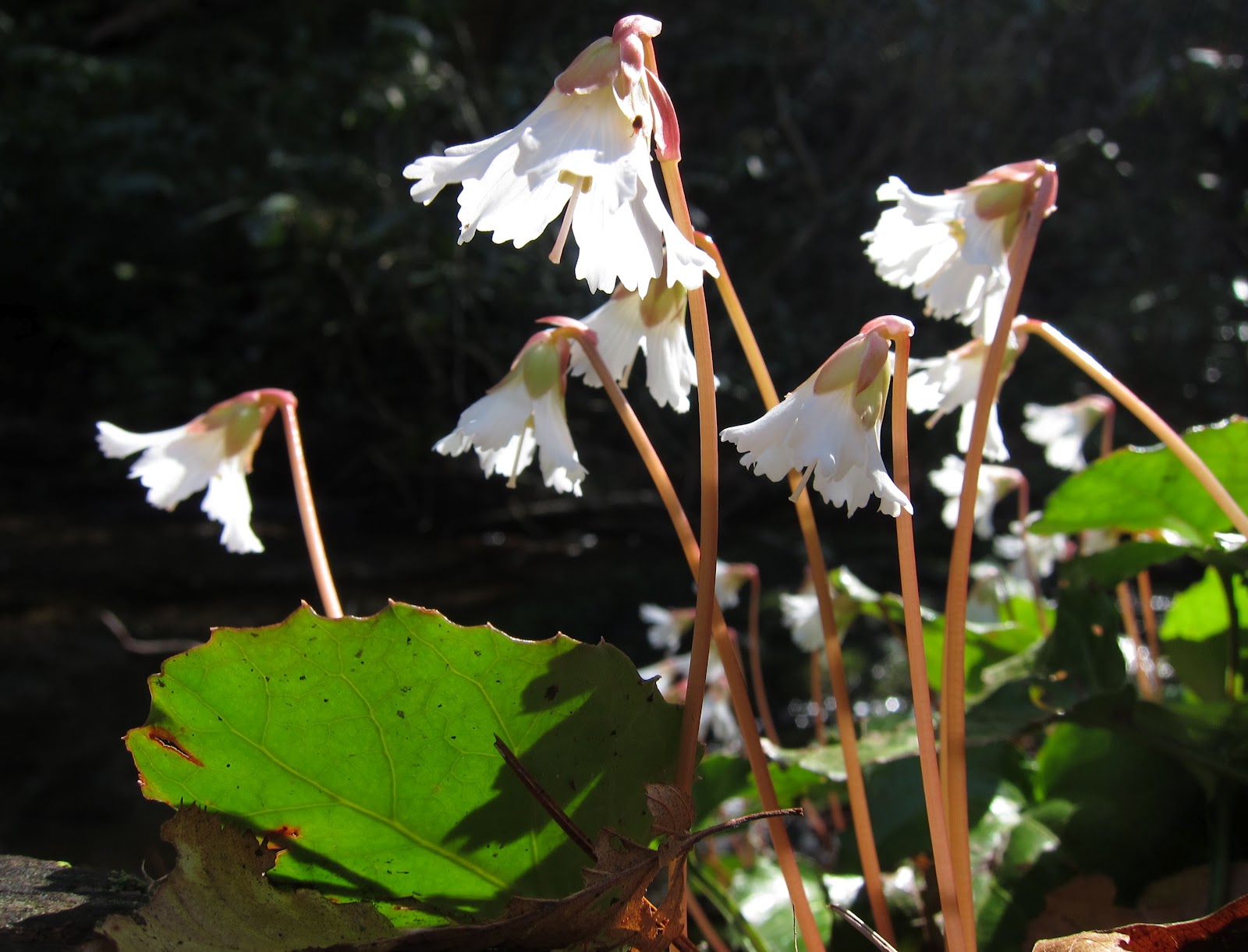
 Not only are gaywings (Polygala paucifolia) improbably cute and small with bursts of fringe, but they also have a hidden secret.  In addition to their regular, colorful and showy flowers, gaywings have hidden, small flowers underground called "cleistogamous" flowers which self-fertilize to make seeds.  The downside of selfing is that the offspring could suffer inbreeding depression, but at least some offspring result, so it may be better than nothing.  With cool fringe on their regular flowers to lure in the bees, it's surprising they need a reproductive back-up plan, but sometimes pollinators are scarce.  Plants in this family (the Polygalaceae) tend to be rare or endemic so there may not always be other plants around to fertilize the regular flowers.  Gaywings in Georgia can be locally abundant, but they are only found in a few sites around here.
Above-ground regular flowers with fancy fringe
I made a special trip to Panther Creek Falls in Habersham Co., Georgia to see these remarkable flowers for myself.  This trail tends to be a popular place, so given my love for quiet, I'd only ever been there in winter.  But it was worth it to brave the crowds over Easter weekend to find the gaywings carpeting the forest floor in simmering lilac.
More gaywings!
In addition to gaywings, there were many other plants in bloom all along the trail. 

Showy orchis
Catesby's trillium
Toothwort (with spider)
This rhododendron attracted a pollinator.

Sunday, April 1, 2012

Trail Dames at the Pocket

"Happiness held is the seed; happiness shared is the flower."  ~Author Unknown

You may have noticed that I've been doing a lot of solo backpacking trips this spring.   But this weekend I took a break from my loner ways, and instead led the Trail Dames on the Third Annual Hike to the Pocket. 

The Pocket of Pigeon Mountain is an extremely special place for wildflowers in Georgia.  The setting is stunning too, with steep rock walls surrounding the valley and a clear blue-green stream and waterfall.  The remote location-- lack of signage, (sometimes rough) dirt road, stream crossing-- combine to keep this place protected.  Though it's several hours drive away, I've taken the time to visit the Pocket repeatedly each season for the past few years and it has always filled me with awe and wonder.

I arrived at the Pocket at dusk the night before the Dames hike, hot tired and cranky after a long drive.  My mood darkened further as I walked around the short boardwalk.  The plants I'd been eagerly anticipating, the Virginia bluebells and poppies, had dropped their petals and gone to seed already.  All I could see was a drab, empty forest.  I was horrified and mad at myself for not changing the timing of the hike to coincide with the earlier emergence and warmer temperatures this year.  I thought, "What if all the Dames were disappointed and felt like I wasted their time bringing them all the way out here?  What business did I have leading hikes anyway?  I didn't know anything!"  I contemplated canceling the hike.  In retrospect, I was having a serious case crankiness and (what I later recognized was ) Imposter Syndrome.
Faded Virginia bluebells
Thankfully, an evening spent listening to owls calling back and forth across the valley, a good night's sleep in my hammock, and an early morning walk around the Pocket cleared my head.  The magic of the place soaked into me.
Morning beauty
Rather than missing the familiar early bloomers,  I noticed flowers I'd never seen before, including wild hyacinth.  Masses of wild blue phlox, wild geranium, and purple phacelia created a sea of purple.  I was actually lucky to have gotten the timing "wrong" and to find these late bloomers I'd missed in previous years.  More importantly, I remembered that the thing I do best (or so I've been told) in leading hikes is sharing my enthusiasm for nature.  I resolved to keep my lack of self-confidence hidden, and try to be myself and be there.
Purple phacelia
Wild geranium
Wild blue phlox
Wild hyacinth
Bent trillium
When the Dames arrived, I watched with delight as everyone started pointing out plants and bugs and a million other things, and asking all sorts of fascinating questions.  I could feel their excitement echoing off the walls of the valley.  They totally felt the magic of the Pocket too!  Listening to their laughter and seeing the wonder in their eyes, I realized that what makes the natural world come alive, more than anything else, is having the opportunity to experience it and share it with friends.

Photo by Jules
Photo by Donna

Please note: if you are lucky enough to visit the Pocket, please keep this place preserved for future visitors and generations by staying on the boardwalk and trails, never ever picking or trampling the flowers, and please pick up the GORP pass (which is now required) to help support this place (there is no way to get one at the site, so order it ahead of time online).

Sunday, March 25, 2012

Quest for Shortia (Part 6): Finishing

On the way to completing my last section of the Foothills Trail (from Laurel Valley to Canebreak), I found Shortia (Oconee Bells) dropping their petals and going to seed.   Two weeks ago, some were in still in bud, and many were open.  It was treat to watch their grand finale too.  I was also excited to be finishing my section hike of this 77 mile trail.
Shortia (Oconee Bells)
I had one of those moments of happiness, for completing something and being in the process of doing something that I loved, and wished I could bottle the feeling up, give it away.  Some of my friends really needed it more than me.  If only there was a way to pass it along...  But it seemed this was the non-transferable types of feelings.  I let it bubble over, and then I went on.

Laurel Fork Falls
The Foothills Trail between Virginia Hawkins Falls and Laurel Fork Falls criss-crossed a stream through a wildflower garden exploding in new spring green.  Patches of bluets, masses of foamflower, a couple of perfoliate belwort, at least four types of violets, pussytoes, jack in the pulpit, dwarf iris, tiny mayapple, even wood betony.  A trillium in bud was getting ready to steal the show.  I'd been wondering what I'd do next-- once the Quest for Shortia and the Foothills Trail were over.  Seeing the forest the color of fresh beginnings, I knew there'd be something out there to find next, even if at the moment, I didn't know what it would be. 
bluets
dwarf iris
violets
On the bank of the Toxaway River, I made camp in a grove of hemlock.  An open beach stretched along the edge of the river, widened by the construction of the reservoir forming Lake Jocassee.  Light rain started the spring peepers chirping.  Mayflies hovered over the river-- they have a single day of adulthood to fly about looking for mates before they drop their eggs into the water and die.  Getting to see them made me feel lucky. 
Toxaway River emptying into Lake Jocassee
Staying dry in the light rain.
The next morning, there was still about a mile to go to reach my previous stopping point, Canebreak.   Crossing the Toxaway River bridge, I paused to take a photo.  My ever-cold hands fumbled with the dials on the camera, dexterity lost to the chill, but I appreciated the discomfort, the cold, thinking about how the oppressive heat of summer would soon be here.

Crossing the Toxaway River
Instead of following the edge of Lake Jocassee, the Foothills Trail goes steeply up and down ridges, hillsides and rock formations.  The term hikers have for this is "P.U.D."  Pointless Up and Down.  I started to curse the slippery wet leaves over the wet wooden stairs.  Then, I recalled something my father would say.  Whenever my sister and I complained we were bored, he would counter "Only boring people are bored."  We learned to cultivate curiosity and the ability to entertain ourselves.  It occurred to me that P.U.D.'s are only "pointless" if you can't see their point.
Pointless?
Is the point this view of the dogwoods?
What would be the point of the trail designers taking the trail up steep ridges, only to go more steeply down the other side, even though it seems like we could have gone near the lake on flat trail and avoided all that elevation change?  To help us burn more calories and build our leg muscles?  To see the view of the lake, and blooming dogwoods dotting the hillsides?  To take us near patches of moss green like the new leaves exploding in the trees the color of optimistic hope?  Or maybe they just love building stairs.  I started to delight in the PUDs.  What else is there to do?  Sometimes happiness comes easily, and sometimes it takes a lot more work to figure it out.

It was only in the 70's and mostly cloudy, and the water was cold, but I decided it was still warm enough to play in the water, and to explore along streambanks.
Cool waters of Virginia Hawkins Falls beckon.
Refreshing!
It is never too early to have lunch.
Lingering near moss and mushroom.
I finally got tired the last hour or so-- the PUDs, the excitement, everything caught up to me.   My pace slackened.  I stopped taking photos of flowers.   All I could dream of were the snacks stashed in the cooler of my car.  I am glad I had to forethought to pack the things I knew would fuel me, would be there I most needed that extra boost to make it home.
Chickpea, asparagus, feta cheese salad with strawberries.

Thursday, March 22, 2012

Wet!

"Never get your down sleeping bag wet" is one of the basic rules of backpacking, and I am rigid when it comes to following the rules.  But this weekend, driving rain blew under my poorly-pitched tarp, and got water on my down underquilt.  I'd been feeling pretty happy with my whole setup and hammock skills, but leave it up to mother nature to show me differently!  When my confidence gets shaken like this, I try to keep in mind something my friend told me-- expertise at something comes only after you've had enough experience to make all the mistakes in the book.

Water-logged bloodroot bent after the storm.
First I learned to pay more attention to the weather.  After dinner, we were watching the pretty lightening show in the distance, up until the moment the storm came upon us fast and fierce.  I should have double checked my pitch earlier.

Second, I also learned just how quickly mild hypothermia sets in.  After I saw rain had reached my underquilt and the end of my hammock, I quickly stashed all my gear in waterproof bags so everything stayed dry, including the "sleep clothes" and shoes I was wearing.  Wearing only my poncho in the storm, it wasn't long before I got cold while I adjusting the tarp.  I felt scared, shivering while the lightening crashed around me, feeling the effects of the hypothermia as my brain got more sluggish.  I did go over to my friend's tent and tell her I was having problems and was shivering-- not that she could do anything, but it felt safer to let them know I was having trouble.  After getting reassurance and my friend's spare tarp just in case, I returned to my hammock, wiped the mud off my bare skin and changed into my dry clothes to get warm.  I was glad I choose to keep my clothes dry while I was out working in the rain, so I'd have something to change into and wet clothes would have kept me colder anyway. 

Third, I still stayed warm with some of my gear wet.  My hammock was wet on the part under my torso, but my sit pad above it keep me insulated.  My pack insulated my legs, and I shook most of the water off my underquilt and it still held some heat.  I was very lucky it didn't get very cold that night.  I fell asleep quickly, and slept like a rock through the night, waking up well-rested.

Since the trip, I have been trying to decide if I should buy new gear, like a new tarp with doors.  I'm reluctant to spend the time researching new gear and then going through the learning curve of a new tarp, a process I find draining.   All I want to do this time of year is be outside, and everything else seems like a waste of time.  The wonderful people at hammock forums also told me how to use my poncho as an improvised door, which would have been really helpful the way the wind was blowing.  Hope I get some good rain this next weekend so I can test that technique out!

Drying out the hammock the next day on Sassafras Mtn., SC

Thursday, March 15, 2012

DIY Hiking Skirt

DIY hiking skirt
I love hiking in skirts.  They are comfortable, and perfect for easy peeing.   Store bought hiking skirts lacked certain, essential features (i.e. big pockets, scientifically accurate flower prints, glitter).  Thankfully, my mom taught me how to sew.  I made a pattern from a skirt that fits well (Melanzana mini skirt).  Rather than getting material from the fabric store, I cut up old shirts, since I'm trying to reuse and recycle more, and sew more of my own gear.

My first skirt was orange fleece.  When I wear my wool long johns under it, static electricity builds and it clings.  But I consider this a "feature" to improve insulation, though I imagine it looks silly.

My second skirt has:
   -Purple glitter thread!
   -Thin, low-profile, elastic waistband is comfy beneath a hipbelt.
   -Zipper pocket in the back for car keys.
   -Cargo pockets with prints of whorled pogonia orchid and trillium.  I xeroxed the images out of my wildflower guidebook, and made the prints on a gocco printer borrowed from a friend (made them a few years ago, but these were leftovers from an old project).

Now, I've got a fancy new outfit for the spring wildflower season.


Whorled pogonia orchid pocket.
Zipper pocket in the back.  Weird fabric leftovers, but I can't see it so who cares?

Sunday, March 11, 2012

Quest for Shortia (Part 4): Found it!

I finally found Shortial!  They were blooming along the bank of a small stream, about four hours after from the Bad Creek Trailhead on the Foothills Trail.  I was doing an overnight solo backpacking trip, hoping to find the plants, and pleasantly surprised they were already blooming, since they are not reported to flower until late March and early April.
Stunningly beautiful Shortia.
Glimmering along the stream bank.
The density of the Oconee Bells increased as I moved east.  The section near the Horsepasture River was like a magical fairy wonderland, with huge masses of Oconee Bells.  How could a remarkable places like this not only provide exceptional beauty but also miles and miles of solitude?  Where were the flocks and flocks of other people crowding around these famed Oconee Bells?  Weren't there a ton of other people who had spent long winter nights reading about these fascinating flowers, eagerly anticipating their unfolding?

Dense patches of Oconee Bells along the Foothills Trail
I flew along the trail, enjoying the peace and quiet, checking out the flowers, grinning ear to ear.  The guidebook says this section of the Foothills Trail (from Bad Creek to Canebreak) is "strenuous" but I didn't notice any steep climbs. (Perhaps I was distracted?)

Stairs?  What stairs?  All I see is shortia!

 When I reached the shore of Lake Jocassee at Canebreak by mid-afternoon, I considered setting up camp.  But seeing the stumps from trees killed during the construction of this reservoir gave me a sick feeling in the pit of my stomach.  The shores were littered with trash, and I could see a few houses on the hillside.  Back in the early 1970's, 4,500 acres of land had been flooded by building a dam to form Lake Jocassee.  This was prime habitat for the Oconee Bell, and it's estimated that 50% of the habitat was lost (Zahner and Jones 1983), and many more populations are threatened by erosion along the shoreline of the lake (Lackey 2004).   Oconee Bells do grow in dense colonies and appears vigorous and hardy, but habitat destruction and population fragmentation are serious threats to this species.

Lake Jocassee
I turned my back on Lake Jocassee, and headed back towards the forest.  The climb out up back into the mountains energized me, and I just kept going and going. I was still smiling from seeing Shortia.

Finally, it started to get really dark, and I found a place midway up a ridge that was tucked out of the wind that I hoped would stay warmer.  After doing some stretching, I went to bed early and I slept soundly, like I usually do in my hammock.

I made a point on this trip to focus on hiking my own pace.  Rather than some arbitrary goal to hike a certain number of miles, I purposefully did NOT calculate my mileage, or my miles per hour like I normally do.  Last year I made it my New Years resolution to hike 20 miles, and I trained hard and felt good about achieving that goal.  Since then, I'd been trying to focus more on enjoying myself, and less on achieving goals.  So, I paid attention to my body, my energy levels, and stopped when I needed to rest, and hiked when I needed to move.  I was tired when I got to my car, but it was that pleasant and contented soreness.  Only when I got home did I calculate that I'd actually hiked a little over 22 miles the first day out-- two miles more than I'd ever hiked before, and I was even carrying a winter-weight backpack.  Ah, such is the inspiring power of Shortia!
Stretched out on a log, taking a rest break with a view of Hilliard Falls.
References:


Lackey, C.E. 2004. The fragmented habitat of Michaux's beautiful discovery: Shortia galacifolia

Zahner, R. and S.M. Jones. 1983. Resolving the type location for Shortia galacifolia T.&G. Castanea 48: 163-173. T.&G. (Diapensiaceae). Castanea 174-177.