Monday, October 21, 2013

Wilderness First Aid

This weekend I took a Wilderness First Aid (WFA) course offered through UGA's Outdoor Recreation Program. This was my third time taking WFA since certification expires ever two years.  But each time I get something new out of the experience.

I first took WFA because it was required for trip leaders for my hiking club, but its worthwhile for everyone that spends extended time in the backcountry.  

WFA teaches lay people (non-medical) to respond to injuries or illnesses that occur where help is one to several hours away.  Of course a 16 hour class can only cover basic medical techniques.  But really the most important things we learn are the decision making process and leadership skills, and how to identify life threatening injuries, stabilize the patient, and get help or get the person to safety.  The training involves a mix of lecture, discussion, and (my favorite) role-playing scenarios to practice our skills.  You'd have been surprised how serious we took the scenarios-- there was fake vomit, wounds made with magic marker, and some excellent acting (not mine!).

Another thing we learn is what questions to ask the patient, how to take vitals, and how to document the information that can be critical for the medical professionals- really helpful to know. 

There is also an emphasis on prevention- similar to what is covered under plan ahead and prepare of Leave No Trace Trainer courses.  We talked about things like ways to assess the skill levels of the group and knowing pre-existing conditions and allergies.

One piece of advice: take this class your hiking partner or coleader.  Both so you can have someone to review with, and to talk over some of the serious stuff.  It can be emotionally charged to role play what it would be like if someone were to be seriously injured on a hike.  I also found myself reviewing all the incidences and mishaps I've encountered over the years on the trail.  Nevertheless, it feels empowering to learn and review safety skills, even though I really hope I never have to use them.

For more information:

Find a WFA program in your area on the American Red Cross webpage.

What to find out what's covered in the course?  Download the pdf of the Reference Guide here.

Sunday, October 13, 2013

Holcomb Creek Trail and Rabun Bald Trail

Roadwalks.  I used to avoid them at all costs.  But lately, I've been stringing together shorter trails with road walks to give me some longer contiguous routes.  This has allowed me to explore some new trails that are only accessible by FS roads (i.e. roads I don't like driving on in my tiny car).  I've found that walking FS roads can be surprisingly pleasant, especially on Sunday mornings when there are no cars out.  And the best thing is that I can make longer backpacking routes if I use FS roads so I get to see some new terrain.

This weekend, I made a partial loop with the Bartram Trail, Rabun Bald Trail, Holcomb Creek Trail, and FS roads.  There were two waterfalls on Holcomb Creek Trail, and fabulous the fall color on Rabun Bald, Georgia's second highest peak.  
Loads of fall flowers were blooming, like this gentian.
I parked at Osage Mountain Overlook just over the NC border, and ascended Rabun Bald on the Bartram Trail.  Before descending Rabun Bald via the Rabun Bald Trail, I took a detour down the Batram Trail to check out a side trial I'd been curious about.  About a mile south of the summit, I reached signed Flint Gap, and the marked side path to Flint Knob (0.7 miles).  The trail was easy to follow, though blazes were sporadic.  Unfortunately, there were no views from Flint Knob, but at least it there was a nice rocky summit to mark the top.   It looks like the trail continues on to a residential community, so I didn't bother going any further, and instead retraced my steps back up Rabun.

After having dinner on Rabun Bald and chatting with some dayhikers, a family was setting up camp at the summit, so I decided to head down the Rabun Bald Trail to find a quieter campsite for the night.  Normally, I wouldn't set up on a ridge, but the views of the fall color were just too pretty.  Plus, I knew I'd be super warm cause I was testing out my brand new, hot off the sewing machine DIY winter karo top quilt (more on this in future posts).
Camping on the leeward side of the ridge
Fabulous sunset view.
The next morning, I continued the steep descent down Rabun Bald Trail, and took a left on the FS road.  After about 20 minutes, I hopped on the Holcomb Creek Trail.  It was sad that the large hemlocks described in the guidebook were all dead, but there were several large tulip poplars and the trail was quite nice.  Holcomb Creek Falls was impressive, and lovely Ammons Creek Falls was framed with brilliant red sourwood which made for quite a sight.
Holcomb Creek Falls.

I'm so glad I got over my aversion to road walks so I could check out some trails I hadn't done before- both Rabun Bald Trail and Holcomb Creek Trail were definite winners!
Holcomb Creek Trail.
Resources:

Trails Illustrated Map #778

Tim Homan's The Hiking Trails of North Georgia

Sunday, October 6, 2013

Arabia Mountain with the Trail Dames

Visiting the yellow daisies at Arabia Mountain has become an annual tradition.  Dramatic display of yellow flowers bloom all over this granite monadnock dome.  An abundance of unique plants adapted to the desert-like conditions are splendid in late fall.
Enjoying the yellow daisies with the wonderful Trail Dames.
I organized a day hike with Trail Dames to Arabia Mountain.  This is great hike for adventurous beginner hikers and nature enthusiasts.  Though it's accessible to Atlanta, it never feels crowded because visitors are dispersed over an extensive trail network, plus there are opportunities for off-trail navigation over open rock faces that are rare in the southeast.
Yellow daisy (also called Confederate daisy though I avoid that name, or Helianthus porteri)
Arabia Mountain is one of the few places around that has rock cairns (piles of stone) to mark the path.  Some parts of the trail were marked with blazes on the exposed rock, so it was easy to compare how much easier it is to navigate with rock cairns and how suited they are for treeless areas.  We also talked about the importance of staying on rock surfaces and treading carefully to avoid stepping on rare plants and lichen.  
Vernal pools still held water even though hasn't rained for a while.  Other depressions in the rock contained dish gardens full of rare plants that look like they could have been landscaped.
Investigating critters in a vernal pool.
Rare black-spored quillwort
If you do visit, be warned that temperatures on the exposed rocks are very extreme.  My favorite time of day to visit is very early morning to catch the soft light and cool air.  In fact, I arrived a few hours before everyone on the day of the hike so I could enjoy the loop before most people wake up.  
dew on purple milkwort
Ladies tresses, a type of orchid.

For more information and trail maps:
Arabia Mountain Nature Preserve Website

Guidebook to the plants:
Guide to the Plants of Granite Outcrops by William Murdy and Eloise Brown Carter.

Sunday, September 15, 2013

Overnight Loop on the Foothills, Winding Stair, and Big Bend Trails

Wanting to explore two trails that link to the Foothills Trail in South Carolina, I devised a 16.4 mile loop for a solo overnight on the Foothills Trail, Winding Stair Trail, and Big Bend Trails.  After section hiking the 77-mile Foothills Trail, I've been hiking all the spurs and side trails that connect to the Foothills because I love the area so much.  This loop turned out to be a very scenic, easy route with four impressive waterfalls and several unnamed smaller falls.  Even the roadwalk had a small waterfall!
Unnamed cascades along the Winding Stair Trail.
I parked at the Foothills Trail access at Cheohee Road (FS 710) right off SC 107.  If I were to do it again, parking at Nicholson Ford would have been safer, but this gave me a shorter drive.  The loop began with a 2.5 mile roadwalk down FS 710.  It was pleasant walking with views through the trees and diverse fall flowers. 

Winding Stair Trail (3.5 miles) headed up into the forest on the left after crossing Crane Creek over a bridge.  The parking area was unmarked but the trail itself was signed and adequately blazed.  This hidden gem is mostly used by dayhikers (i.e. no campsites evident).  Broad switchbacks wound gently up the hillside so the 1000 foot elevation gain was effortless.   Paths to two waterfalls required steep scrambles down rhododendron thickets, with much ducking required for tall people.  Miuka Falls was an impressive 70-foot cascade and Secret Falls was smaller but picturesque.  

After crossing SC 107, Big Bend Trail led 2.7 miles to the Chattooga River Trail/Foothills Trail.  It passed through really pretty forest, typical for the Chattooga River area, with large trees, doghobble lined streams, and mountain laurel.  Pine-needle cushioned trail made for easy walking. 
Pinesap lacks chlorophyll and gets its carbon by parasitizing fungi associated with pine trees.
Giant pines on the Big Bend Trail
Off the Foothills Trail, steep social trails through rhododendron tangles crisscrossed the riverbank overlooking Big Bend Falls.  You could feel the ground rumbling as the powerful Chattooga River thundered through narrow canyon.  I never did get a good photo, but believe me it's worth seeing (and hearing!).
Camping along the Chattooga River.
I set up camp on a sandy beach north of Rock Gorge along the Chattooga River.  After being focused on hiking and the trail, I finally had some time to think.  It was a tough week at work- I received the unexpected news that the funding for my job is ending sooner than I'd been previously told, and I'd been feeling very unsettled the past few days.  Thankfully, watching the sun set and the moon rise above the hills over the river was quite restorative.

The Chattooga River is one of those really special places for me.  I feel so at home in the forests through which it flows.  Its large evergreen trees, rhododendrons and ferns remind me of the forest of my childhood in Oregon.  I have made so many memories of trips on the trails that intersect the Chattooga- the Foothills, Bartram, and Chattooga River Trail.  It's tough thinking about leaving this place and all the friends I've made here, but it's also exciting to dream about what I'll do next. 

I woke early to hike the few miles to my car on the Foothills Trail, passing yet another falls.  It was a short trip, but exactly what I needed.
Lick Log Falls on the Foothills Trail.
For more information:

Tim Homan's Hiking Trial of the Southern Nantahala Wilderness and Chattooga River.

Trails Illustrated #778 Brasstown Bald and Chattooga River

Tuesday, September 10, 2013

On the JMT... of Tennessee

I couldn't help boasting about this trip, "This weekend, I'm backpacking the JMT… of Tennessee!"
The John Muir National Recreation Trail goes 20 miles along the Hiawassee River gorge in eastern Tennessee.  John Muir traveled this route on his long walk from Kentucky to the Gulf of Mexico, and Muir's description  (see here- read under Sept 19) of the incredible river still aptly describes the wonder of this river today.  
Water levels were low enough to exposed the unique jagged rock formations of the Hiawassee River.
My friend Salt and I began at the western end at Childers Creek trailhead, and we highly recommend the scenic first 3 miles to Big Bend.  It's well maintained and follows the northern bank of the Hiawassee River below towering bluffs.  The Benton Mackaye Trail Section 13 is concurrent with this part of the JMT.  
Fascinating geology and diverse plant community including pawpaws, one of my favorites.
Past Big Bend Parking Area, Hiawassee River Road is popular with fishermen, and there are frequent parking areas and boat launches with trashcans, picnic tables, and bathrooms.  The area (especially the nearby Ocoee River) is also a mecca for whitewater rafting and kayaking, and we wondered a few times why were hiking rather than staying cool in the water like the fishermen and boaters.
Joe pye weed along the Hiawassee River.
Lunch at one of the many picnic areas along Hiawassee River Road.
From Big Bend to Towee Creek, the trail left the river and ascended a very short distance up the hillside.  We stayed within sight of the road so it was pretty much like walking along road, only rougher and more difficult.  I'm not sure point of this but it did take us to an overlook along some rock formations.

The 2008 reroute between Towee Creek and Wildcat Creek led further away from the river and up over a tall bluff.  We followed beautiful Towee Creek before switchbacking up to the spine of the ridge.  It was a hot humid climb and we were dripping in sweat.  Afterwards we joked that we'd bagged a 14er.  Such bad-ass JMT hikers!  Of course it was only a 14-hundered footer, but whatever...
It was hard going.  Gnats were especially vicious and kept flying into nose, eyes, and ears. 
Our original plan had been to camp at Coker Creek, but the heat and mugginess had sapped so much energy that we decided not to go any further.  Hammocks were hung above a bluff over Wildcat Creek.  We had dinner under a rocky overhang, and soaked tired feet in the river while swatting (unsuccessfully) at the blood-thirsty no-see-ums.

In the morning, we decided to follow the old route of the JMT/BMT on the return trip to the car.  The section was much more used and still marked with signs and blazes all the way to the suspension bridge over the Hiwassee River and the Apalachian Power House.
Walking along the old route (rather than the reroute) provided lovely views of the river.  There were fishermen out all along this peaceful stretch of water.
The old trail markers showed where the old route used to veer off the road into dense forest along the riverbanks.  We followed the blazes through really overgrown trail and eventually got tired of fighting the thick brush.  We suspect other hikers also must walk the road which was much more pleasant.  Though I wonder how many people hike this stretch- we certainly didn't see any other backpackers, just one dayhiker, and lots of fishermen.
Overgrown section.
Just before we got back to the trailhead, as I was strolling along looking up at the pawpaw, Salt shouted something from behind me.
Looking up at the tons of pawpaws all along the trail.
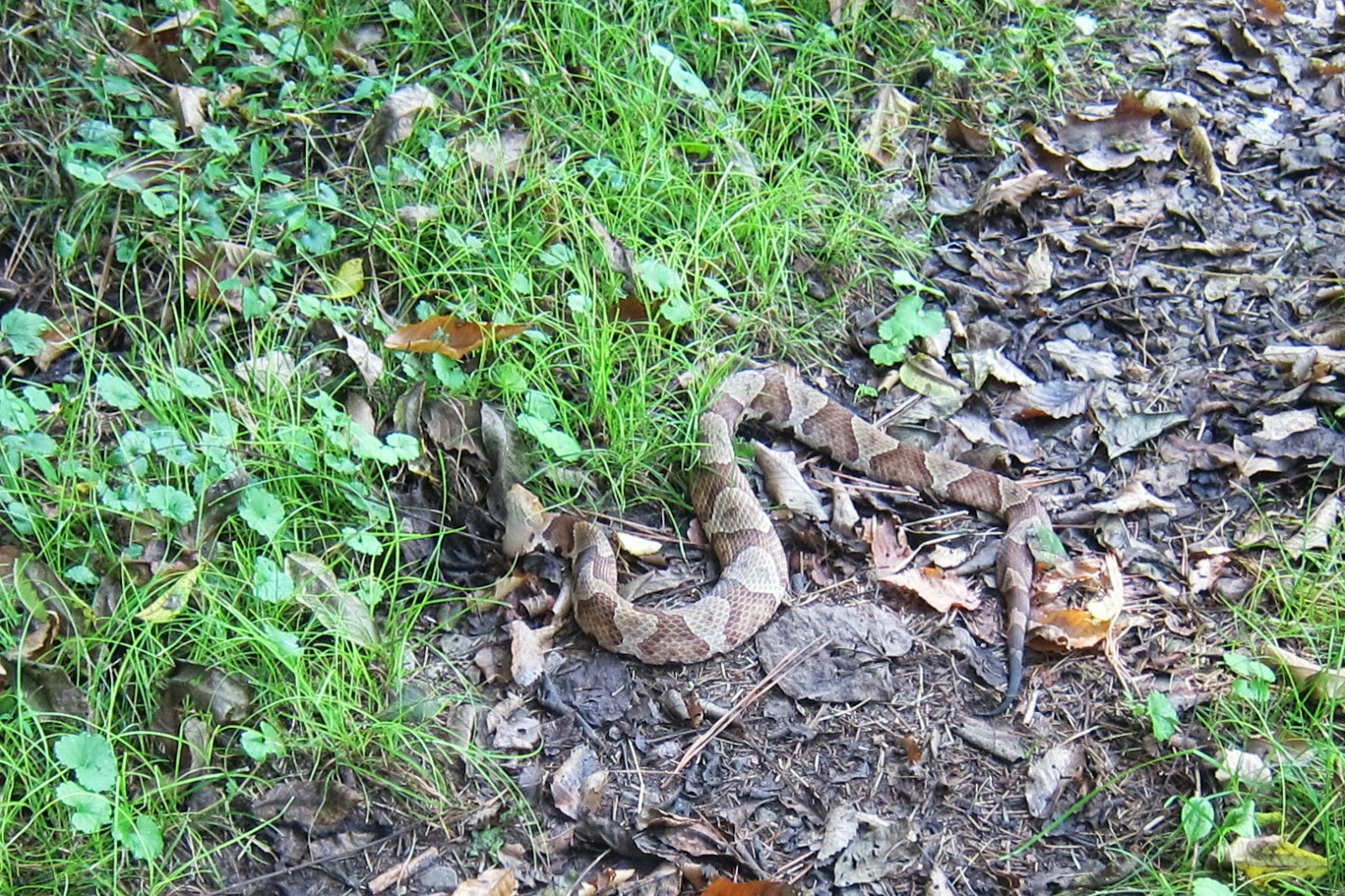
I walked a few steps further before turning around.  She exclaimed that I'd stepped on a snake!   Sure enough there was a copperhead in the path looking very angry. 
Anyway, she saw the snake move when I stepped on it, but it didn't bother me, not even a nibble.  And he looked to be still very alive.  Ironically, she'd just been talking about seeing a snake and how snakes are reported to be common along this section of trail.  I've since read that copperhead bites are really rare, that they only inject venom half the time anyway, and thought it's painful, hardly ever deadly.  Not that I'd ever step on one on purpose, but it's another thing that I'm not gonna fear.

Overall, the first few miles of the JMT from Childers Creek were exceptionally pretty and I think they'd make a fantastic day hike, especially in fall or winter when the weather wouldn't be so brutally hot.  It was great to be on the trail with my friend Salt and on the way home we scouted out the next trailhead for the BMT so I'll look forward to returning to this area for more adventures.

Information and trip planning notes
(note: information on the John Muir National Recreation Trail was really disappointing and lacking so I've included an annotated description of resources.)

Sherpa Guides has some regional information here.

The BMT Trail Guide for Tennesse showed the old and new reroute, which was helpful.  However, it wasn't as detailed about the confusing road crossings.

The Trails Illustrated map #781 Tellico and Ocoee Rivers is easier to read than the trail guide, and shows road access.  However, it didn't show the old BMT route, even though both new and old routes are still signed and blazed.  Potentially very confusing.

This Backpacker Magazine article on the JMT at least had directions to the trailheads and for the shuttle.  However, it doesn't describe the reroute even though it was published in 2010, and the description made us wonder if the author had actually hiked the trail.

Unfortunately, the BMTA trail descriptions that had been so helpful for sections 1-11 are not available for this section, but a map is available for free download.

Friday, September 6, 2013

Side Trails off the Foothils Trail, Part 2

Labor Day weekend on the Foothills side trails continues... (see here for Part 1)

After a restful night on Sassafras Mountain (highest point in South Carolina), my friend Still Waters and I drove over to the  Frozen Creek Access Area to begin the second part of the trip- an 18 mile loop through Gorges State Park in North Carolina on the Auger Hole, Foothills, and Canebreak Trails. 

I was both suspicious and thrilled that the trailhead was deserted when we arrived.  There had to be a good reason for that on a holiday weekend and I figured we'd soon find out.
Auger Hole Trail.
The 7.3 mile Auger Hole Trail wasn't the prettiest trail.  Wide doubletrack, thick spiderwebs, biting gnats.  It took effort to find beauty.  Brilliant green tiger beetles scampered up the trail.  Sometimes, you just have to settle for the little things.
Brief break from the heat at the crossing of the Toxaway River on the Auger Hole Trail.
When the trail opened up into a hot powerline cut, there was especially slippery loose gravel and rock.  Ugh.
I'm usually sure-footed, but I fell going down this steep part.
I was overjoyed to finally reach the soft surface of the Foothils Trail and step back into verdant forest.  While the Oconee Bells weren't blooming like when I'd backpacked this section last March, their lush evergreen leaves glistened along the banks of small babbling streams.  At first glance, they might look like galax, but you can tell they are actually the rare Oconee Bells by the leaf venation patterns. All thoughts of the previous section of tough trail were overshadowed by the botanical splendor.  A selective memory does wonders for ones general happiness.
Bridge over small stream on the Foothills Trail.
After 13 miles of solitude, I was pissed off when I heard motorboats and loud voices as I descended to the banks of Lake Jocassee.  I lightened up a bit when I saw kids frolicking in the shoals where the Toxaway River empties into the lake.  I was even more pleased when they all took off in their boats in the evening as the thunderstorms rolled through, leaving us in peace.
Morning light at the Toxaway River flowing into Lake Jocassee.
Next morning, it was five miles up the Canebreak Trail.  I honestly can't think of an uglier trail.  
The initial steep ascent up the Canebreak Trail, which follows more old roads.
Loose gravel make for tough walking on tired feet.
In an ideal world, there'd be more places that offered both solitude and scenic splendor.  But as it is, there is a tradeoff- in this case (ugly) trails provided solitude.  We encountered no other backpackers all weekend, though there were a few folks out for the day within a mile of the trailheads.  For a holiday weekend, it was worthwhile to put up with the trails over old roads to have some quiet and stay off the beaten track.  Plus, these trails led to places that were spectacular, despite being crowded with daytrippers that accessed them with their cars (on Sassafras Mtn) and motorboats (at Lake Jocassee).  It worked out well to have some of the best of both worlds.
The only other footprints on these trails were made my turkeys.
For more information on this loop:

Backpacker Magazine article.

Meanderthals Trip Report here.

Tuesday, September 3, 2013

Side Trails off the Foothills Trail, Part 1

Ever since I finished my hike of the Foothills Trail last year, I've been wanting to do the Foothills Spur as well as two side trails that form a loop with the Foothill Trail through Gorges State Park.  So I did a rather unusual configuration this Labor Day weekend to backpack all these trails.  My friend Still Waters give me a shuttle the first day, and then we drove to a different trailhead for the second night.  The extra driving was worthwhile because these side trails provided opportunities for exploring and adventure, and also had exceptional solitude.

Foothills Spur: Caesars Head to Sassafras Mountain (14.2 miles)

The first day my friend Still Waters drove me to Caesars Head State Park.  The Foothills Spur shares tread here with the Raven Cliff Falls Trail and the Gum Gap Trail, which had been closed when we'd visited the park a few weeks ago.
Starting out in fog on gentle trail.
After the first few miles, the Foothills spur follows a series of old roads, some of which I was delighted to learn were built in the 1930's by the CCC.  Often rocky, these roads made for difficult hiking and much time was spent looking around for rather sparse or worn blazes and consulting the map.
Warning sign say to stay on blazed trails to avoid getting lost.
The trail passes through the Watson-Cooper Heritage Preserve, which has the only montane bog in South Carolina, and harbors several rare plants.  An old book gave rough directions to the bog which involved unmarked/ unmaintained trails that I wanted to check out so I can go back next spring when the swamp pink are in bloom. I got totally wet and covered in mud from stooping under rhododendron thickets and tromping around in the bushes.  What fun, though I wished I'd only been carrying a daypack instead of my backpacking pack.  I was also really happy too not to get lost after passing those warning signs.  
Not very rare, but still pretty yellow fringed orchid at Watson-Cooper Heritage Preserve
Venturing down an unmarked side trail provided the most spectacular view of the day.  From the summit of Bursted Rock Mountain (3219 feet), an expansive rocky outcrop opened up to the south for a view of what I think must be Table Rock.  I stumbled upon this by veering south off the Foothills Spur (less than a mile east of Dolves Mountain) and following the orange blazes marking the NC/SC border for about a quart of a mile strait up the mountain.  Not sure how many people know about this place because it was really overgrown.
Rocky expanse on Bursted Rock Mountain.
View from Bursted Rock (though the geological marker said "Bursting Rock").
The view from Dolves Mountain was much easier to find- it was right on the trail- but not quite as impressive. 
Looking north from Dolves Mountain.
When the trail finally turned into the woods onto singletract path, the terrain got very steep, though I was relieved for the soft trail.  This switchback-free trail following spine of mountain along NC/SC border all the way up to Sassafras Mountain (3553 feet), the highest point in South Carolina.
Big steps up.
I met Still Waters up at the summit, and we watched bats swoop across the sky as the sun set. 
Watching the sunset from Sassafras Mountain.

Stay tuned for Part 2...

For more info on the Foothills Spur Trail:

     Meanderthals Trip Report here.

     Foothills Trail Map.

     Johnny Molloy's Long Trails of the Southeast.