Thursday, March 15, 2012

DIY Hiking Skirt

DIY hiking skirt
I love hiking in skirts.  They are comfortable, and perfect for easy peeing.   Store bought hiking skirts lacked certain, essential features (i.e. big pockets, scientifically accurate flower prints, glitter).  Thankfully, my mom taught me how to sew.  I made a pattern from a skirt that fits well (Melanzana mini skirt).  Rather than getting material from the fabric store, I cut up old shirts, since I'm trying to reuse and recycle more, and sew more of my own gear.

My first skirt was orange fleece.  When I wear my wool long johns under it, static electricity builds and it clings.  But I consider this a "feature" to improve insulation, though I imagine it looks silly.

My second skirt has:
   -Purple glitter thread!
   -Thin, low-profile, elastic waistband is comfy beneath a hipbelt.
   -Zipper pocket in the back for car keys.
   -Cargo pockets with prints of whorled pogonia orchid and trillium.  I xeroxed the images out of my wildflower guidebook, and made the prints on a gocco printer borrowed from a friend (made them a few years ago, but these were leftovers from an old project).

Now, I've got a fancy new outfit for the spring wildflower season.


Whorled pogonia orchid pocket.
Zipper pocket in the back.  Weird fabric leftovers, but I can't see it so who cares?

Sunday, March 11, 2012

Quest for Shortia (Part 4): Found it!

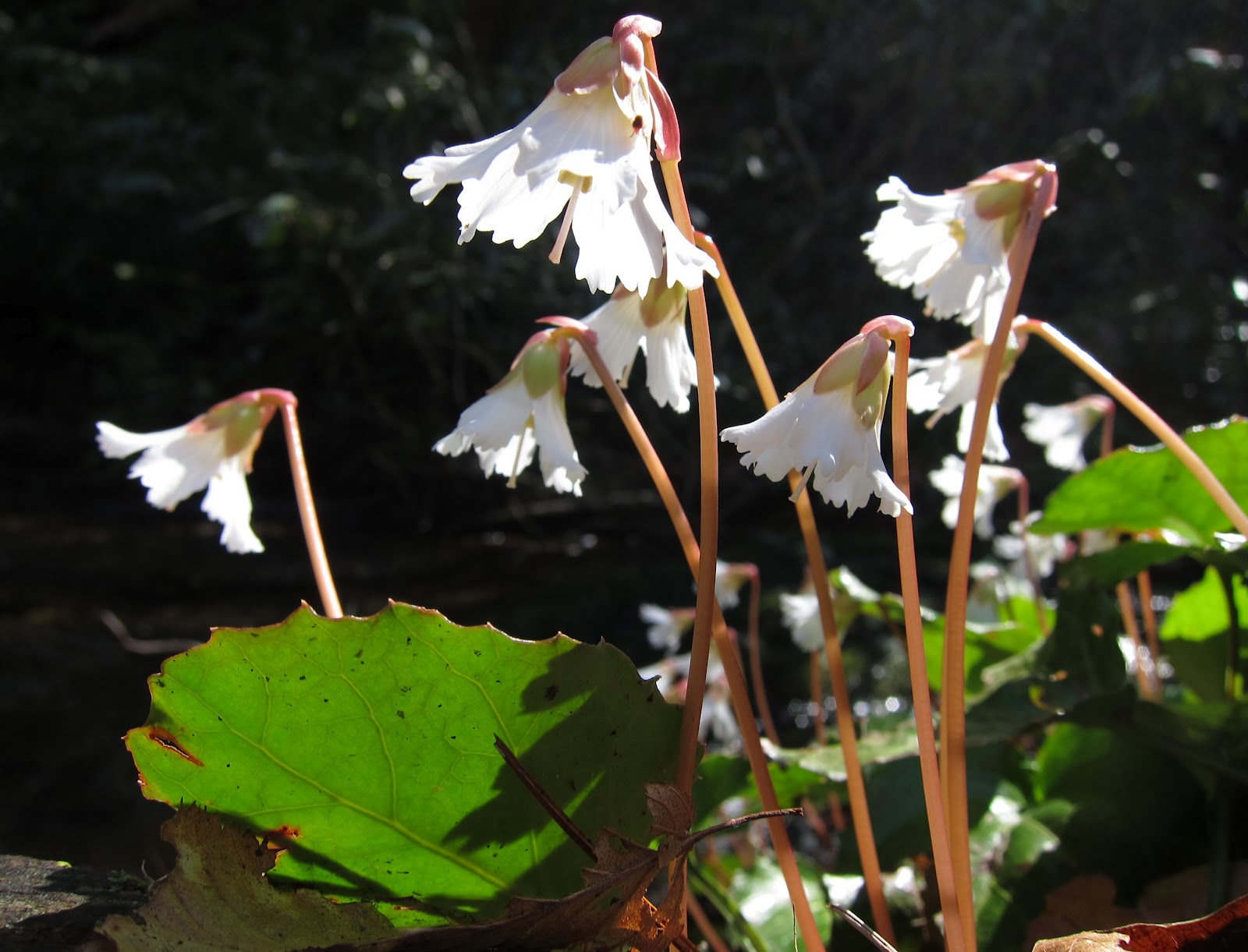
I finally found Shortial!  They were blooming along the bank of a small stream, about four hours after from the Bad Creek Trailhead on the Foothills Trail.  I was doing an overnight solo backpacking trip, hoping to find the plants, and pleasantly surprised they were already blooming, since they are not reported to flower until late March and early April.
Stunningly beautiful Shortia.
Glimmering along the stream bank.
The density of the Oconee Bells increased as I moved east.  The section near the Horsepasture River was like a magical fairy wonderland, with huge masses of Oconee Bells.  How could a remarkable places like this not only provide exceptional beauty but also miles and miles of solitude?  Where were the flocks and flocks of other people crowding around these famed Oconee Bells?  Weren't there a ton of other people who had spent long winter nights reading about these fascinating flowers, eagerly anticipating their unfolding?

Dense patches of Oconee Bells along the Foothills Trail
I flew along the trail, enjoying the peace and quiet, checking out the flowers, grinning ear to ear.  The guidebook says this section of the Foothills Trail (from Bad Creek to Canebreak) is "strenuous" but I didn't notice any steep climbs. (Perhaps I was distracted?)

Stairs?  What stairs?  All I see is shortia!

 When I reached the shore of Lake Jocassee at Canebreak by mid-afternoon, I considered setting up camp.  But seeing the stumps from trees killed during the construction of this reservoir gave me a sick feeling in the pit of my stomach.  The shores were littered with trash, and I could see a few houses on the hillside.  Back in the early 1970's, 4,500 acres of land had been flooded by building a dam to form Lake Jocassee.  This was prime habitat for the Oconee Bell, and it's estimated that 50% of the habitat was lost (Zahner and Jones 1983), and many more populations are threatened by erosion along the shoreline of the lake (Lackey 2004).   Oconee Bells do grow in dense colonies and appears vigorous and hardy, but habitat destruction and population fragmentation are serious threats to this species.

Lake Jocassee
I turned my back on Lake Jocassee, and headed back towards the forest.  The climb out up back into the mountains energized me, and I just kept going and going. I was still smiling from seeing Shortia.

Finally, it started to get really dark, and I found a place midway up a ridge that was tucked out of the wind that I hoped would stay warmer.  After doing some stretching, I went to bed early and I slept soundly, like I usually do in my hammock.

I made a point on this trip to focus on hiking my own pace.  Rather than some arbitrary goal to hike a certain number of miles, I purposefully did NOT calculate my mileage, or my miles per hour like I normally do.  Last year I made it my New Years resolution to hike 20 miles, and I trained hard and felt good about achieving that goal.  Since then, I'd been trying to focus more on enjoying myself, and less on achieving goals.  So, I paid attention to my body, my energy levels, and stopped when I needed to rest, and hiked when I needed to move.  I was tired when I got to my car, but it was that pleasant and contented soreness.  Only when I got home did I calculate that I'd actually hiked a little over 22 miles the first day out-- two miles more than I'd ever hiked before, and I was even carrying a winter-weight backpack.  Ah, such is the inspiring power of Shortia!
Stretched out on a log, taking a rest break with a view of Hilliard Falls.
References:


Lackey, C.E. 2004. The fragmented habitat of Michaux's beautiful discovery: Shortia galacifolia

Zahner, R. and S.M. Jones. 1983. Resolving the type location for Shortia galacifolia T.&G. Castanea 48: 163-173. T.&G. (Diapensiaceae). Castanea 174-177.

Sunday, March 4, 2012

Quest for Shortia (Part 3): Distracted by Trillium

Tallulah Gorge State Park lists Shortia (Oconee Bell) on it's list of rare plants, so I decided to continue my quest for finding it there.

At the bottom of the gorge, the sparkle of a plant caught my eye.  Not Shortia as I'd hoped, but nevertheless something that registered as "unusual".  Like a trillium, though quite small, and not yet fully open.  Heart pounding with excitement, I stretched as far out over the railing as possible, to get a good look.  I continued on my quest, going twice around the loop, up and down all the steps, and down all the side trails, so I could pay attention to each side of the trail with my full attention, but no Shortia!

Back at the visitors center, I read the display on the federally endangered "persistent trillium" found only in and near Tallulah Gorge.  It's called "persistent" because leaves stay on the plant into September, while most other trilliums dye back in summer.   First success: finding a new (to me) rare trillium!

Persistent Trillium
I also asked about the Oconee Bell at the visitor's center, but the rangers didn't know about it.  I was actually happy, in a strange way, not to find it, because it wouldn't be a proper quest if I'd found it so quickly.  Therefore, my second success was NOT finding Shortia.

The next day, I went over to the native flora garden at the State Botanical Gardens of Georgia in Athens to confirm my identification of the persistent trillium.  They have an excellent collection of trilliums, including a few labeled specimens of the persistent trillium which were in flower and looked exactly like the one I'd seen at the bottom of Tallulah Gorge.

For more info on the Persistent Trillium, read the Master's Thesis by Cassandra Plank called "Demography and Community Characterization of the Federally Endangered Herb, Trillium persistens: A study across its range including fire-dependent habitat.  A link to the pdf is here.

Sunday, February 26, 2012

Quest for Shortia (Part 2): Not it!

I don't expect to find Shortia (Oconee Bells) this weekend, but that wasn't going to stop me from looking.  It's too early for them to be in bloom, but I could still hunt for their characteristic leaves.  I decided to do a solo, overnight, out-and back backpacking trip along the Foothills Trail from Burrells Ford Road to Whitewater Falls where I wasn't as likely to find them.  That way I could save more promising sections for later in the spring, and still check this section off my to-do list. 

At home, I etched the image of the Oconee Bell leaf in my brain, especially in comparison to galax.  I memorized features of its habitat and the list of plants it's likely to be found with (rhododendron, hemlock, near streams on north facing slopes).  I knew I was finally reaching the point of being totally obsessed when I started dreaming of Oconee Bell leaves.

While hiking, I honed my search image.  I practiced recognizing and distinguishing any evergreen plants with roundish leaves, so my brain learned what was NOT Oconee Bell. 

Heartleaf- NOT it!

Even though I didn't find the Oconee Bell, the trip was a special because I got a clear view of the moon, Venus, and Jupiter all in a together in the sky. 

Monday, February 13, 2012

Quest for Shortia (Part 1): How it Starts

Late winter finds me pulling out my plant guidebooks, flipping through looking for inspiration.  Last year was my hunt for the yellow lady slipper orchid and a "mystery plant" (turned out to be Wood's bunchflower).  This year I decided would be the year for Shortia galacifolia, commonly known as the Oconee Bell.

It began the year after I moved here.  My friends would ask, "Have you seen the Oconee Bell?  The trail guide mentions this section has Oconee Bells, let's keep an eye out."  But I never quite get the timing right.  And I never knew the fascinating botanical story behind this remarkable plant.  This year would be different because I'd become captivated by the story of the Oconee Bell.  And I'd start my quest of it earlier in the season.  And I'd stay off the high mountaintops of NC, which has historically been where people go wrong finding Shortia.

The quest was on!

Sunday, February 5, 2012

Bartram Trail from Warwoman Dell

It was my first solo backpacking trip in a long time, and I was nervous about going alone.  I was pushing my comfort zone on the weather-- forecast was for cold and rainy.  I made it to the trailhead (Warwoman Dell) by listening to my CD mix of happy, inspiring, empowering music.  I started hiking by telling myself that I could always turn around and go home if I got too scared, but just to try hiking for a little bit and see what would happen.

But within the first half hour of hiking (north up the Bartram Trail), even though there was hardly any rain, I saw tree foam!  It seemed like magic to spot that bright sparkle at the base of a tree.  But there it was bubbling and glistening.  My whole mood shifted, I could feel the fierce grip on my hiking poles soften, and my body relax.  After that, I had those moments of hiking bliss where the worries in my head disappeared and I experienced flow.

Tree foam!
When it got dark, I found a stealth spot to camp out of view from the trail.  By the time I hung the bear rope and hammock, it was only 6:30-- but already very dark and cold.  What do you do, alone in the woods?  I am not fond of campfires, and I didn't want to night hike in case I couldn't find the way back to my campsite, which was carefully hidden.  But since I was alone, I realized I could do whatever I wanted to, and there was no one for miles around to care.  The songs I'd listened to on the drive up crept into my head.

And I started to dance.  Slowly at first.  Then, with complete and happy abandon.  Dancing alone under the clouds, hands waving in air, rocking out, twirling, swishing, feeling happy in my body, moving enough to stay warm despite the falling temperatures.  Moving to the music in my head, then to the music of the wind in the trees.  The clouds parted occasionally, beams of moonlight casting shadows on the forest.  Bliss.


I zipped up into my hammock by 7:30, completely content.  Drops of rain started to fall on the tarp, but I was cozy warm.  I slept long and more comfortably than I ever do at home.  By morning the clouds had parted again, and I watched the sunrise from the comfort of my hammock.


I was glad I pushed myself by going out alone, despite my fears.  I needed all that time to reflect and relax, and be by myself.  And I had everything I could ever need out there alone.

Sunday, December 11, 2011

Winter Hiking: Cheaha Wilderness

View at McDill Point in the Cheaha Wilderness.  Wearing a skirt I sewed myself.
This weekend, Still Waters and I went out to scout the Pinhoti- Cave Creek Loop which winds 7.2 miles through the Cheaha Wilderness of Alabama, two hours west of Atlanta.  The overall elevation change was gentle, but the trail featured delightful boulder fields perfect for rock hopping and romping.  This was a great hike for winter because there were lots of views that would have been covered up had there been leaves on the trees.  We followed these very good (and entertaining) directions paying particular attention not to miss any of the side trails.

Part of this loop hike took us along the Pinhoti Trail, which is another long distance trail that extends through Alabama and Georgia and connects to the Appalachian Trail.  I've hiked other sections of this trail including through the Dugger Wilderness as well as parts in Georgia, and every time it inspires me to spend more time exploring this trail.

Only 2,504 miles to Kathadin.
The viewpoint out at McDill Point was especially worth the 1/4 mile trip down the side path.  There, we had lunch out of the icy wind, and gazed in wonder at one particular tree in the valley below that still clung to its red leaves.  It was surrounded by a forest of green pine and the bare brown branches of other deciduous tree that had all already lost their leaves.  It stood out so brightly, all by itself.

Single bright red lone tree in a forest of pine and bare trees.
In the absence of plants and fungi, my usual favorite things to investigate on the trail, the moss/ lichen provided endless sources of fascination.  Seeing such incredible diversity almost makes me want to learn more about them and figure out how to identify them.  Until I looked at the guide to lichen that  my co-worker showed me.  I was drooling over the photos, but am completely intimidated by the keys, and the book is way too massive to take into the field.  I think I'll stick with admiring the lichen from afar for now, even though I know I'm missing out on that joyful wonder that only comes for me from a more in-depth understanding of organisms when I learn more about their ecology and natural history.

Beautiful lichen


The rocks were another highlight of the hike.  They were lovely shades of gray and white, and were unmistakably not-Georgia rocks like I'm used to seeing.  They made neat stacked formations, and in other places were piled up in boulder fields. 

Rock formations